
Puerto Rico
From Spanish colonial pesos to the 2009 “Isla del Encanto” quarter — Puerto Rico’s coinage is a compact, fiercely collected story: one provincial silver series (1895–1896), a dollar conversion in 1900, and the first U.S. circulating coin to carry Spanish text.
Coins of Puerto Rico
Every coin entry in this wiki — one tap to the full page.
Showing 6 of 6
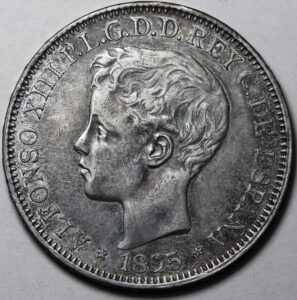 1895 Alfonso XIII One PesoPuerto Rico’s Silver CrownView coin ›1896 Puerto Rico 10 Centavosthe Conditionally Rare FractionalView coin ›1896 Puerto Rico 40 Centavosthe Big FractionalView coin ›
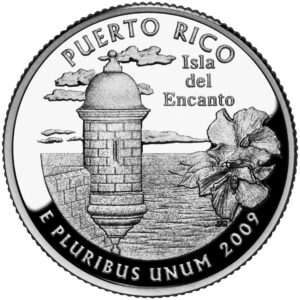 2009 Puerto Rico Quarter“Isla del Encanto”View coin ›
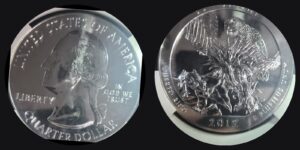 2012-P El Yunque 5 oz Silver Quarter (America the Beautiful)Photo by CapsCoinsandTreasuresOverview The 2012-P El Yunque 5 oz Silver Uncirculated Coin honors El Yunque National…View coin ›
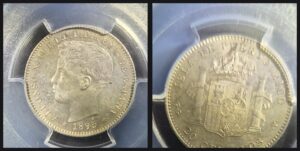 Puerto Rico 20 Centavos 1895 & 5 Centavos 1896the Provincial FractionalsView coin ›
The short answer
Puerto Rico uses the U.S. dollar (USD) — the same money as the rest of the United States. The island adopted the dollar in 1900, replacing the Puerto Rican peso at 60 cents U.S. per peso. Locals still call the dollar the peso in everyday speech: one peso, one dollar.
For the full story — the colonial peso, the 1900 conversion, and the coins collectors hunt — read the deep dive: What Is Puerto Rico’s Currency?
Puerto Rico’s currency history
- Spanish colony from 1493 (Columbus’s arrival) to 1898; Spain ceded Puerto Rico to the United States under the Treaty of Paris, December 10, 1898.
- Under Spain the currency was the Puerto Rican peso, divided into 100 centavos and equal to 5 Spanish pesetas — “1 PESO = 5 P.TAS” on the coins themselves.
- The island’s only own coinage: the 1895–1896 provincial series (five denominations), struck at the Madrid mint. Earlier circulation was dominated by countermarked foreign coins (notably a fleur-de-lis countermark applied in 1884) and Mexican silver.
- Currency conversion, Act of April 12, 1900: Puerto Rican pesos were redeemed at 60 cents U.S. per peso — not at par — and the redeemed silver coins were melted at the Philadelphia Mint.
- The Foraker Act (1900) ordered the provincial peso out of circulation. The Banco Español de Puerto Rico was renamed the Bank of Porto Rico and issued dollar-denominated notes; the bank was liquidated in 1913.
The coins: Puerto Rico’s own issues
- Alfonso XIII provincial silver (1895–1896): 1 peso 1895, 20 centavos 1895, and 5, 10, 40 centavos 1896 — Madrid mint, the young king’s portrait by Bartolomé Maura (fineness: .900 for the 1 peso; .835 for the 20 and 10 centavos; the 5 centavos’ fineness is disputed).
- 2009 Puerto Rico quarter (District of Columbia & U.S. Territories program): the San Juan sentry box (garita) and the hibiscus with “ISLA DEL ENCANTO” — the first U.S. circulating coin with Spanish text.
- 2012 El Yunque 5 oz silver quarter (America the Beautiful): honors Puerto Rico’s tropical rainforest.
What collectors hunt
- The 1895 peso in high grade — the 8.5-million mintage was savaged by the post-1900 U.S. melting of redeemed coins.
- The 1896 10 centavos (700,000 struck) — conditionally rare; even MS64 examples rank among the finest known.
- The 1896 40 centavos (725,000 struck) — the big fractional; certified mint-state examples are so scarce that none is currently listed anywhere.
- The tiny 1896 5 centavos (600,000 struck, 16 mm) — scarce in high grade.
- 2009 quarters: low-mintage circulation issues (P 53.2 million, D 86 million — among the lowest of the State/Territories era) plus 2009-S 90% silver proofs.
- 1895 Alfonso XIII One Peso — Puerto Rico’s Silver Crown
- 1896 Puerto Rico 40 Centavos — the Big Fractional
- 1896 Puerto Rico 10 Centavos — the Conditionally Rare Fractional
- Puerto Rico 20 Centavos 1895 & 5 Centavos 1896 — the Provincial Fractionals
- 2009 Puerto Rico Quarter — “Isla del Encanto”
- 2012-P El Yunque 5 oz Silver Quarter (America the Beautiful)
- A core path through Puerto Rico coinage — the 9-coin collection checklist
Colonial market watch
We scan certified eBay listings for the 1895–1896 colonials every day. As of October 16, 2026, no certified mint-state example of the 1895 peso, the 1896 40 centavos, or the 1896 10 centavos is listed anywhere. Best certified asking prices right now: 1895 peso — NGC AU58 at $2,030; 1896 40 centavos — PCGS XF45 at $600; 1896 10 centavos — PCGS XF40 at $325. Recent realized prices: the peso’s AU55 at $1,500 (September 2026) and the 10 centavos’ AU50 at $359.99 (August 2026); the 40 centavos has seen just one certified sale in 90 days — a Details coin at $306. At Heritage in 2026, mint-state pesos realized $2,196–$4,148 and an MS62 10 centavos brought $585.60. Each coin’s page carries its own tracking notes, updated as the market moves.
Frequently Asked Questions
What currency does Puerto Rico use?
Puerto Rico uses the U.S. dollar (USD) — the same currency as the rest of the United States. U.S. coins and bills circulate island-wide, and prices are quoted in dollars and cents.
What is Puerto Rico’s currency?
Puerto Rico’s currency is the U.S. dollar. The island adopted the dollar in 1900, when Puerto Rican pesos were redeemed at 60 cents U.S. per peso under the Act of April 12, 1900.
Does Puerto Rico use the U.S. dollar?
Yes. As a U.S. territory, Puerto Rico has used the U.S. dollar as its official currency since 1900. Travelers from the mainland need no currency exchange.
Why do Puerto Ricans call the dollar “peso”?
Colloquial habit. Before 1900 the island’s currency was the Puerto Rican peso, and many Puerto Ricans still say peso in everyday speech when they mean the U.S. dollar — one peso, one dollar.
Did Puerto Rico ever have its own coins?
Yes — one provincial silver series (1895–1896): five denominations struck at the Madrid mint — the 1 peso of 1895, the 20 centavos of 1895, and the 5, 10, and 40 centavos of 1896, all bearing the young Alfonso XIII’s portrait.
Why are high-grade Puerto Rican pesos so scarce?
After the 1900 conversion, redeemed provincial silver was shipped to the Philadelphia Mint and melted. The 1895 peso’s 8.5-million mintage was savaged by that melting, so high-grade survivors are rare and fiercely collected.
What U.S. coins honor Puerto Rico?
Two standouts: the 2009 Puerto Rico quarter — the San Juan sentry box (garita) and hibiscus with “ISLA DEL ENCANTO” — and the 2012 El Yunque 5 oz silver quarter from the America the Beautiful program, honoring the island’s tropical rainforest.
Real prices come from real sales. Check what Puerto Rico coins are actually selling for right now.
Live eBay listingsSee live Puerto Rico dealsMatching checklists & toolsAs an eBay Partner, The Coin Wiki may earn from qualifying purchases.
FREE DOWNLOAD
Before you spend that coin, check it.
The Pocket Change Key-Date Checklist covers the cents, nickels, dimes, quarters and halves still hiding in circulation — including the 1943 and 1983 errors worth five figures. One page to print, a lifetime of jars to check.