
Specifications
- Denomination
- guide
- Series
- Japanese era dates
Japanese coins don’t show Gregorian years — they show the emperor’s reign era (nengō) plus a year number in kanji. This guide gives the exact conversion rules (Showa N + 1925, Heisei N + 1988, Reiwa N + 2018), a full 1949–2026 conversion table, and where to find the date on every current denomination.
How the nengō system works
- Japan dates coins by imperial reign era (nengō, 元号), not the Gregorian year. The date inscription is the two-kanji era name followed by kanji numerals and 年 (nen, “year”). Example: 令和5年 = Reiwa 5 = 2023. (MyKoyns — Decoding Dates on Japanese Yen Coins)
- The three eras covering modern coinage: Showa (昭和) Dec 25, 1926 – Jan 7, 1989; Heisei (平成) Jan 8, 1989 – Apr 30, 2019; Reiwa (令和) May 1, 2019 – present. (Microsoft Learn — JapaneseCalendar.Eras)
- Conversion formulas: Showa N = 1925 + N; Heisei N = 1988 + N; Reiwa N = 2018 + N. (Sensei’s Library — Japanese Era Conversion)
- Kanji numerals on coins: 一=1, 二=2, 三=3, 四=4, 五=5, 六=6, 七=7, 八=8, 九=9, 十=10. Tens multiply then add: 二十 = 2×10 = 20, so 昭和四十五年 = Showa 45. The character 元 (gannen, 元年) means “first year of the era” — e.g. 平成元年 = Heisei 1 = 1989. (MyKoyns; Wikipedia)
Key transition years
- **1989 = Showa 64 = Heisei 1.** Emperor Hirohito died Jan 7, 1989; Showa 64 lasted only 7 days (Jan 1–7). Coins dated Showa 64 were struck and exist — Showa 64-dated production continued into March 1989. Heisei began Jan 8, 1989 (Heisei gannen, 平成元年). (Microsoft Learn; Wikipedia — 1 yen coin)
- **2019 = Heisei 31 = Reiwa 1.** Heisei ran Jan 1 – Apr 30, 2019 (Akihito’s abdication Apr 30); Reiwa began May 1, 2019 with Naruhito’s enthronement (Reiwa gannen, 令和元年). Heisei 31-dated coins exist — e.g. 1,118,000 Heisei 31 50-yen coins were struck in 2019. (Wikipedia — Reiwa era)
Conversion table: 1949–2026
| Gregorian | Era date on coin | Gregorian | Era date on coin |
|---|---|---|---|
| 1949 | Showa 24 (昭和24年) | 1988 | Showa 63 (昭和63年) |
| 1950 | Showa 25 | 1989 | Showa 64 (Jan 1–7) / Heisei 1 (Jan 8–Dec 31) |
| 1951 | Showa 26 | 1990 | Heisei 2 |
| 1952 | Showa 27 | 1991 | Heisei 3 |
| 1953 | Showa 28 | 1992 | Heisei 4 |
| 1954 | Showa 29 | 1993 | Heisei 5 |
| 1955 | Showa 30 | 1994 | Heisei 6 |
| 1956 | Showa 31 | 1995 | Heisei 7 |
| 1957 | Showa 32 | 1996 | Heisei 8 |
| 1958 | Showa 33 | 1997 | Heisei 9 |
| 1959 | Showa 34 | 1998 | Heisei 10 |
| 1960 | Showa 35 | 1999 | Heisei 11 |
| 1961 | Showa 36 | 2000 | Heisei 12 |
| 1962 | Showa 37 | 2001 | Heisei 13 |
| 1963 | Showa 38 | 2002 | Heisei 14 |
| 1964 | Showa 39 | 2003 | Heisei 15 |
| 1965 | Showa 40 | 2004 | Heisei 16 |
| 1966 | Showa 41 | 2005 | Heisei 17 |
| 1967 | Showa 42 | 2006 | Heisei 18 |
| 1968 | Showa 43 | 2007 | Heisei 19 |
| 1969 | Showa 44 | 2008 | Heisei 20 |
| 1970 | Showa 45 | 2009 | Heisei 21 |
| 1971 | Showa 46 | 2010 | Heisei 22 |
| 1972 | Showa 47 | 2011 | Heisei 23 |
| 1973 | Showa 48 | 2012 | Heisei 24 |
| 1974 | Showa 49 | 2013 | Heisei 25 |
| 1975 | Showa 50 | 2014 | Heisei 26 |
| 1976 | Showa 51 | 2015 | Heisei 27 |
| 1977 | Showa 52 | 2016 | Heisei 28 |
| 1978 | Showa 53 | 2017 | Heisei 29 |
| 1979 | Showa 54 | 2018 | Heisei 30 |
| 1980 | Showa 55 | 2019 | Heisei 31 (Jan 1–Apr 30) / Reiwa 1 (May 1–Dec 31) |
| 1981 | Showa 56 | 2020 | Reiwa 2 (令和2年) |
| 1982 | Showa 57 | 2021 | Reiwa 3 |
| 1983 | Showa 58 | 2022 | Reiwa 4 |
| 1984 | Showa 59 | 2023 | Reiwa 5 |
| 1985 | Showa 60 | 2024 | Reiwa 6 |
| 1986 | Showa 61 | 2025 | Reiwa 7 |
| 1987 | Showa 62 | 2026 | Reiwa 8 |
Worked examples
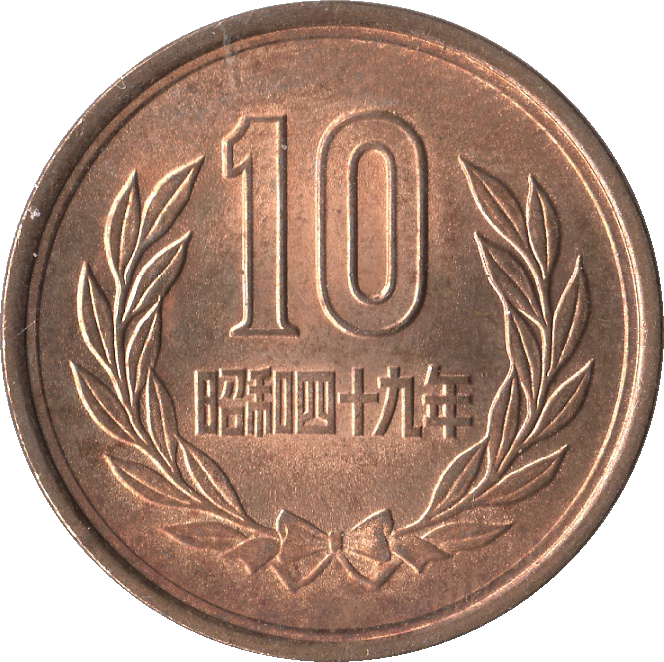
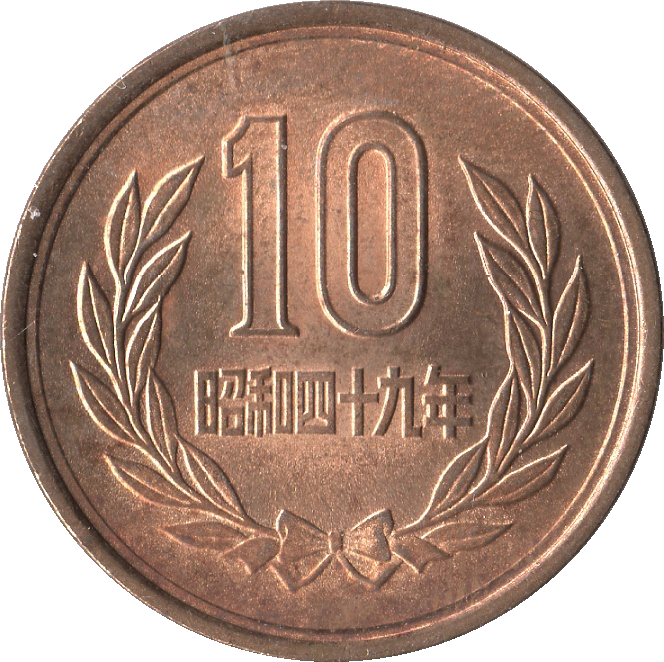
- 昭和45年 = Showa 45 → 1925 + 45 = **1970**
- 平成12年 = Heisei 12 → 1988 + 12 = **2000**
- 令和3年 = Reiwa 3 → 2018 + 3 = **2021**
Where the date sits on each denomination
- On the **reverse** of all six current denominations, in kanji, low on the coin. (Wikipedia — Japanese yen)
- ¥1 reverse: value + year of minting. ¥5 reverse: state title (日本国) + year of minting. ¥10 reverse: evergreen tree, value + year of minting. ¥50 reverse: value + year of minting. ¥100 reverse: value + year of minting. ¥500 reverse: bamboo, mandarin orange, value + year of minting.
- The state title 日本国 and the value in kanji are on the obverse in most cases — the 5-yen is the exception, with 日本国 on its reverse alongside the date.
Collector notes
- **No mint marks:** Japanese circulation coins carry no mint marks — dating is by era and year only. There is no mint-letter or branch-mint variety to collect. (Cnumis)
- **Kōki (imperial year) is not used on coins.** Kōki 2600 = 1940 (counted from Emperor Jimmu’s legendary accession in 660 BCE); it was used for military equipment names such as the “Zero” fighter, but coin dates always use the reign-era (nengō) year. (Wikipedia — Japanese imperial year)
- **1989 and 2019 each have two era dates.** Always read the kanji era name first: 昭和64年 and 平成元年 are both 1989; 平成31年 and 令和元年 are both 2019.
- **Reading direction:** modern Showa-era and later coins read left-to-right; Meiji and Taishō era coins read right-to-left. (MyKoyns)
Market check
Compare live listings for this coin on eBay:
Search eBay for How to Read Dates on Japanese Coins: Showa, Heisei & Reiwa Era Guide
As an eBay Partner, The Coin Wiki may earn from qualifying purchases.
FREE DOWNLOAD
Before you spend that coin, check it.
The Pocket Change Key-Date Checklist covers the cents, nickels, dimes, quarters and halves still hiding in circulation — including the 1943 and 1983 errors worth five figures. One page to print, a lifetime of jars to check.