
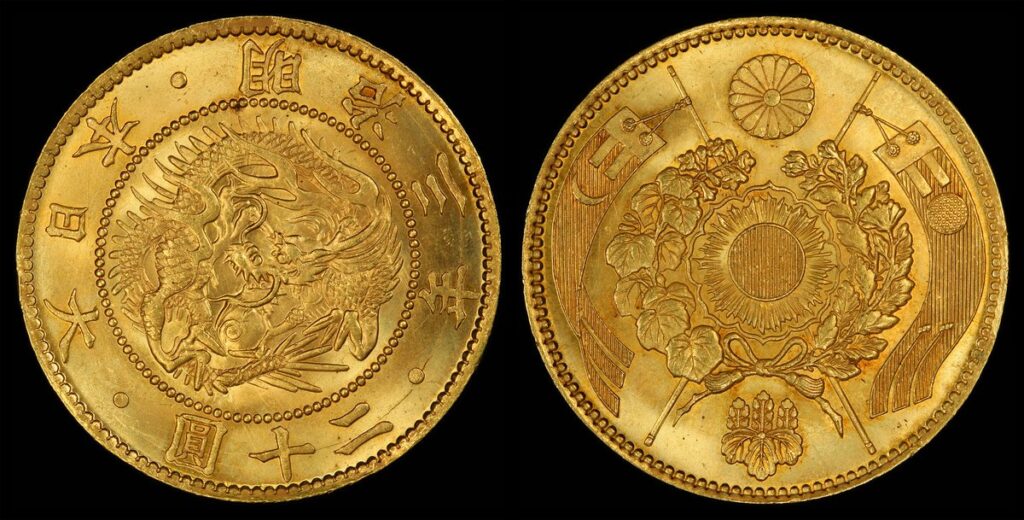
The 20 yen gold piece was the most valuable circulating coin of the yen system for 85 years — a big, .900-fine dragon coin that anchors any serious Japanese collection. This entry covers its specs, design, and the six-figure rarities in the series.
Key facts
- First issued in 1870 (Meiji Year 3), struck sporadically until 1892; composed of .900 fine gold at 33.3333 g and ~35.06 mm diameter (currency catalog data).
- Obverse: a dragon within a beaded border, with the state title “Great Japan” and the date in Meiji regnal years written right to left; reverse: a sunburst over the sacred mirror (Yata no Kagami) with the imperial chrysanthemum seal above and the paulownia government seal below (currency catalog data).
- It was the highest-denomination yen coin until the 50 yen piece arrived in 1955 (currency catalog data).
- Key rarities: a 20 yen dated Year 10 (1877) realized $840,000 at auction — very few were made, possibly struck for presentation to officials or dignitaries (Nasdaq roundup); Year 3 (1870) examples in high grade brought ~$44,000–$46,000 at a Spink-Taisei Tokyo sale (Numismatic News).
- The 1880 (Year 13) proof 20 yen — original mintage 103, fewer than 10 believed surviving — is among the rarest Japanese coins of any era; an NGC PF64 Cameo example led Heritage’s 2017 NYINC sale at $305,500 (Numismatic News).
Market check
As an eBay Partner, The Coin Wiki may earn from qualifying purchases.
FREE DOWNLOAD
Before you spend that coin, check it.
The Pocket Change Key-Date Checklist covers the cents, nickels, dimes, quarters and halves still hiding in circulation — including the 1943 and 1983 errors worth five figures. One page to print, a lifetime of jars to check.