
Specifications
- Denomination
- 500 yen
- Series
- Japanese yen — circulating coinage
- Years of issue
- 2000–2021
- Composition
- 72% Copper, 20% Zinc, 8% Nickel
- Weight
- 7 g
- Diameter
- 26.5 mm
- KM
- Y#125
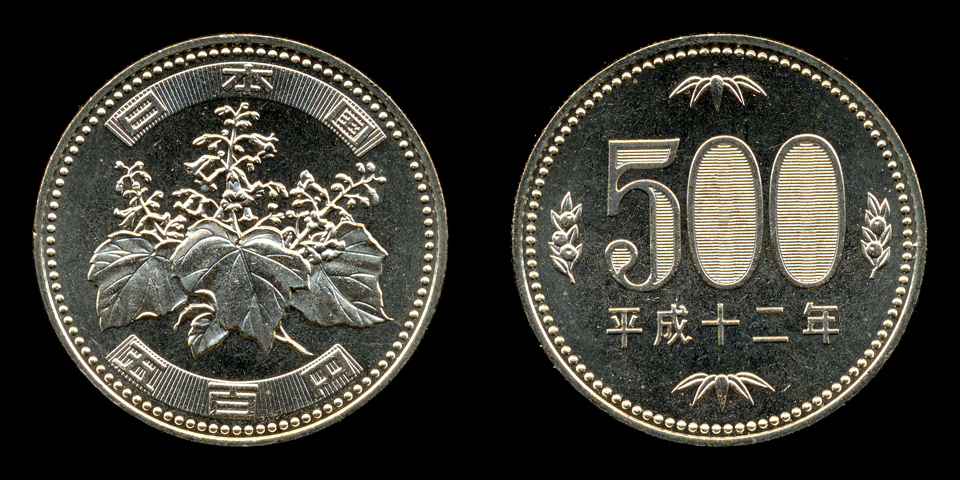
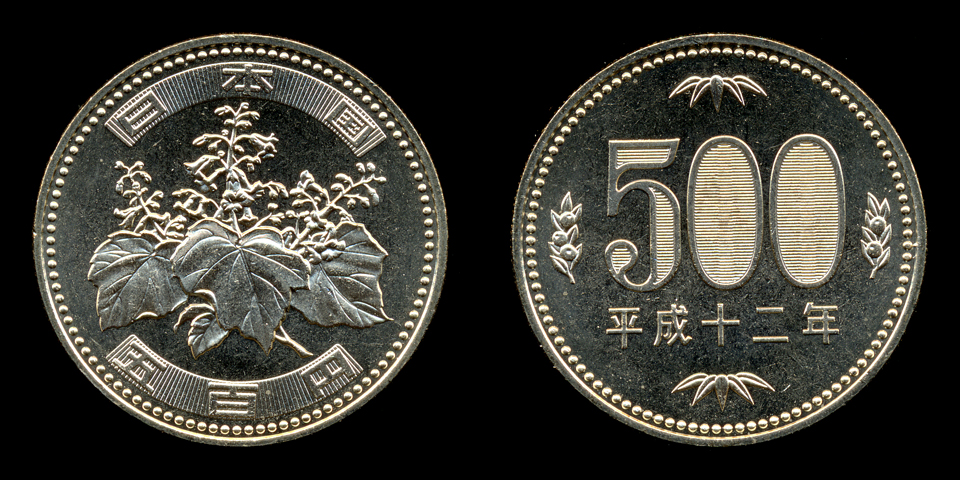
Issued 2000–2021 (Heisei 12 – Reiwa 3), the nickel-brass 500 yen (72% copper, 20% zinc, 8% nickel; 7.0 g, 26.5 mm) was Japan’s answer to a counterfeiting epidemic — with a slanted reeded edge, a latent image in the “500” and “NIPPON” micro-lettering. It remains legal tender today.
History
- The 500 yen denomination was created in 1982 to serve the vending-machine industry; the original 1982–1999 type was cupronickel, 7.2 g, with a lettered edge. (Numismatic News)
- Counterfeiters exploited South Korea’s 500 won coin — same diameter and metal content but ~1/10 the value — drilling holes in won coins to match the 500 yen’s weight; Japanese police found 657,000 altered coins between January and October 1999. (Numismatic News)
- In 2000 the Mint switched to nickel-brass (Cu 72% / Zn 20% / Ni 8%) and cut the weight to 7.0 g; the zinc gives vending machines an “electronic signature” (conductivity) to authenticate the coin, and machines were reprogrammed to recognize it. (Numismatic News)
- Anti-counterfeit devices added in 2000: a latent image inside the two zeroes of the “500” (visible when the coin is tilted) and the word “NIPPON” in micro-printing on each face; the edge became slanted (diagonal) reeding. (Numismatic News; SoraNews24)
- Obverse: paulownia (桐) with 日本国 and 五百円; reverse: bamboo (竹), mandarin orange (橘) and “500” with the nengo date — e.g. 平成十二年 (Heisei 12 = 2000) on the first-year coin. (Ministry of Finance; Wikimedia Commons photo)
- Struck 2000–2021; 2021 was a transition year with both nickel-brass (184,711,000) and the new bicolor clad (170,222,000) produced. The Ministry of Finance lists the nickel-brass type as “Valid (in Use)” — still legal tender, circulating alongside the bicolor coin. (Japan Mint; Ministry of Finance)
- Lowest-mintage years: Reiwa 1 (2019) at 76,956,000; Heisei 25 (2013) at 137,892,000; Reiwa 2 (2020) at 143,928,000; Heisei 27 (2015) at 143,004,000. (Japan Mint)
- Even the redesign was eventually beaten: by 2012 “extremely well crafted” fake 500 yen coins, believed made in China or South Korea, were defeating ATMs — the direct trigger for the 2021 bicolor-clad replacement. (Numismatic News)
Key dates and varieties
- Reiwa 1 (2019): 76,956,000 — series low (Heisei 31 portion of 2019: 126,164,000)
- Heisei 25 (2013): 137,892,000
- Reiwa 2 (2020): 143,928,000
- Heisei 27 (2015): 143,004,000
- Heisei 26 (2014): 167,013,000
- Reference: first year Heisei 12 (2000): 595,969,000 — final year Reiwa 3 (2021): 184,711,000
- All figures: Japan Mint annual production, calendar year, thousands of pieces, commemoratives excluded, rounded.
Specifications
- Denomination: 500 yen — Years: 2000–2021 (Heisei 12 – Reiwa 3)
- Composition: Nickel-brass — copper 72%, zinc 20%, nickel 8% (Cu 720 / Zn 200 / Ni 80 per mille). (Ministry of Finance)
- Weight: 7.0 g — Diameter: 26.5 mm. (Ministry of Finance)
- Edge: Slanted (diagonal) reeding. (Numismatic News)
- Mint marks: None — no mint marks used.
- Catalog: Y#125. (NGC)
Collector notes
- Tell it from the 1982–1999 cupronickel type by weight (7.0 g vs 7.2 g), edge (slanted reeding vs lettered edge reading “NIPPON ◆ 500 ◆”), and color (golden nickel-brass vs silvery cupronickel) — a scale settles it. (Numismatic News; Ministry of Finance)
- Tell it from the 2021+ bicolor type by the uniform golden color — the bicolor coin has a visibly two-tone ring (nickel-brass) and core (cupronickel). (Numismatic News)
- Authentication check: tilt the “500” — a genuine 2000+ coin shows a latent image in the zeroes; look for “NIPPON” micro-letters on both faces. (Numismatic News; SoraNews24)
- Still legal tender and still encountered in change; the Finance Ministry estimated ~5 billion 500 yen coins of all types in circulation at the 2021 changeover. (Ministry of Finance; AJMEDIA)
- The date is on the reverse under the “500” as a nengo date. (Ministry of Finance)
Market check
Recent eBay sales
The wiki started tracking eBay sales for this coin on September 26, 2026. Confirmed sales will appear here as our monitor observes them — check back in a few days.
Compare live listings for this coin on eBay:
Search eBay for Japan 500 Yen Nickel-Brass
As an eBay Partner, The Coin Wiki may earn from qualifying purchases.
FREE DOWNLOAD
Before you spend that coin, check it.
The Pocket Change Key-Date Checklist covers the cents, nickels, dimes, quarters and halves still hiding in circulation — including the 1943 and 1983 errors worth five figures. One page to print, a lifetime of jars to check.