
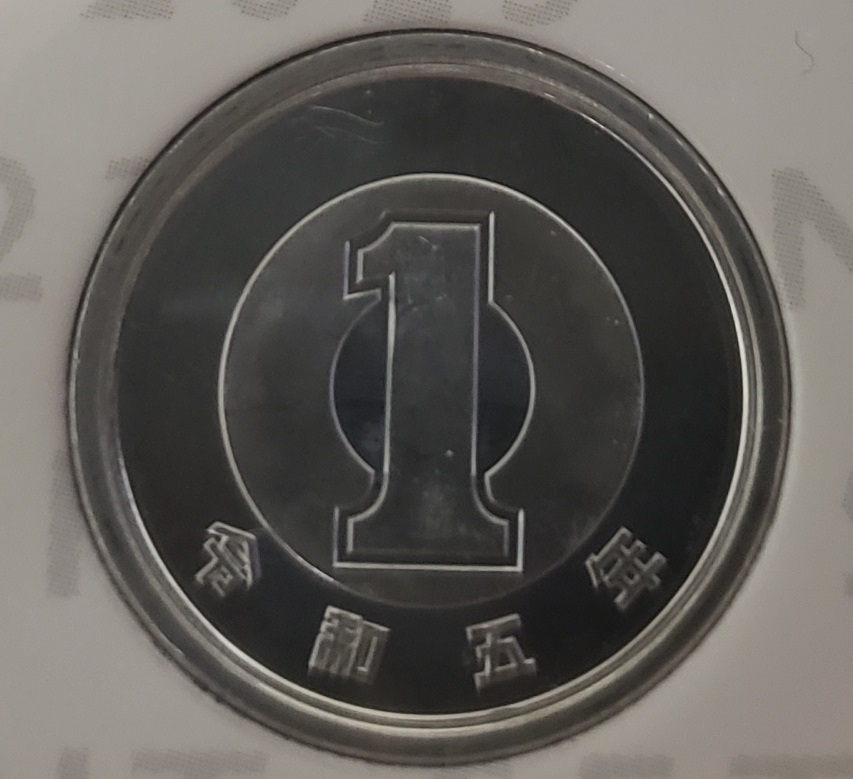
Specifications
- Denomination
- 1 yen
- Series
- Japanese yen — circulating coinage
- Years of issue
- 1955–present
- Weight
- 1 g
- Diameter
- 20 mm
- Edge
- Plain
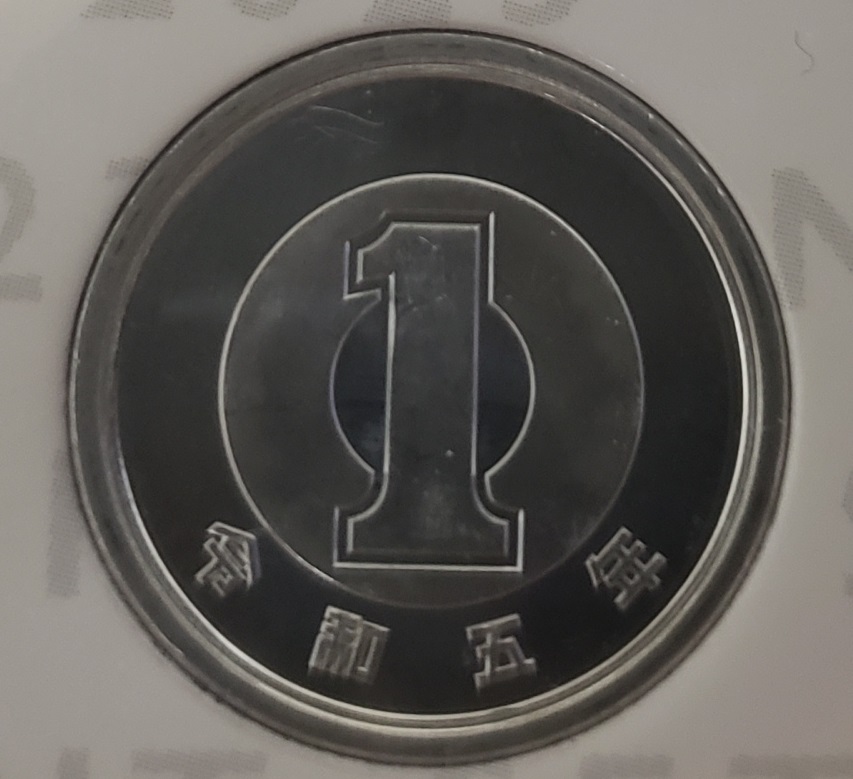
Japan’s 1 yen coin has carried the same young-tree design since the aluminum type debuted in 1955 (Showa 30): pure aluminum, 1.0 g, 20.0 mm — the lightest circulating coin in Japan and the oldest unchanged design in current production.
History
- The 1 yen denomination began in the early Meiji era as a silver coin; the modern aluminum type was first issued in 1955 (Showa 30), replacing a short-lived brass 1 yen struck 1948–1950. (Numismatic News; Japan Mint)
- The Japan Mint calls it the oldest design among coins presently manufactured — the design has never changed since 1955. (Japan Mint)
- Obverse: a young tree symbolizing Japan’s healthy growth, with 日本国 above and 一円 below; reverse: a large “1” with the nengo date below. (Japan Mint; Numista)
- Struck in pure aluminum at just 1.0 g and 20.0 mm, it is so light it will float on still water. (Japan Mint; Numismatic News)
- No 1968-dated coins were issued — the Japan Mint’s official production table shows zero for 1968, following overproduction in surrounding years. (Japan Mint)
- In 2011–2013 and 2016–2017 the 1 yen was struck only for mint sets (440,000–659,000 pieces); Numismatic News reported in 2018 that each coin cost about ¥3 to manufacture — three times its face value. (Numismatic News; Japan Mint)
- It remains legal tender and is still minted (2024: 511,000 pieces), and is the lowest denomination in circulation. (Japan Mint; Numismatic News)
Key dates and varieties
- 1955 (Showa 30): first year of the aluminum type — 381,700,000 struck. (Japan Mint)
- 1968: no coins exist for this date (official production: zero). (Japan Mint)
- Mint-set-only low years — 2011: 456,000; 2012: 659,000; 2013: 554,000; 2016: 574,000; 2017: 477,000; 2018: 440,000 (2011–2013 and 2016–2017 confirmed mint-set-only by Numismatic News). (Japan Mint; Numismatic News)
- 2024: 511,000 — another very low year. (Japan Mint)
- All figures: Japan Mint annual production, calendar year, rounded, commemoratives excluded.
Specifications
- Denomination: 1 yen — Years: 1955–present (Showa 30 – Reiwa 8)
- Composition: Aluminum — 100% aluminum. (Japan Mint; Numista)
- Weight: 1.0 g — Diameter: 20.0 mm — Thickness: 1.2 mm. (Japan Mint; Numista)
- Edge: Plain. (Numista)
- Mint marks: None — no mint marks used. (Numista)
- Catalog: Y#74 (Showa, N#1590); Y#95 (Heisei, N#983); Y#283 (Reiwa, N#182978); JNDA# 02-13. (Numista)
Collector notes
- Read the date on the reverse under the large “1” — it’s a nengo date (e.g. 昭和五十五年 = Showa 55 = 1980). (Numista)
- No 1968-dated 1 yen exists — the official production table shows zero for that year, so treat any “1968” as suspect. (Japan Mint)
- The 2011–2013 and 2016–2018 issues were struck only for mint sets (440,000–659,000 pieces); expect a premium over face for those dates. (Japan Mint; Numismatic News)
- Pure aluminum is soft and marks easily — never clean a 1 yen coin; bright original surfaces carry the value. At exactly 1 gram it even floats on still water. (Japan Mint; Numismatic News)
Market check
Recent eBay sales
The wiki started tracking eBay sales for this coin on September 26, 2026. Confirmed sales will appear here as our monitor observes them — check back in a few days.
Compare live listings for this coin on eBay:
Search eBay for Japan 1 Yen Aluminum
As an eBay Partner, The Coin Wiki may earn from qualifying purchases.
FREE DOWNLOAD
Before you spend that coin, check it.
The Pocket Change Key-Date Checklist covers the cents, nickels, dimes, quarters and halves still hiding in circulation — including the 1943 and 1983 errors worth five figures. One page to print, a lifetime of jars to check.