
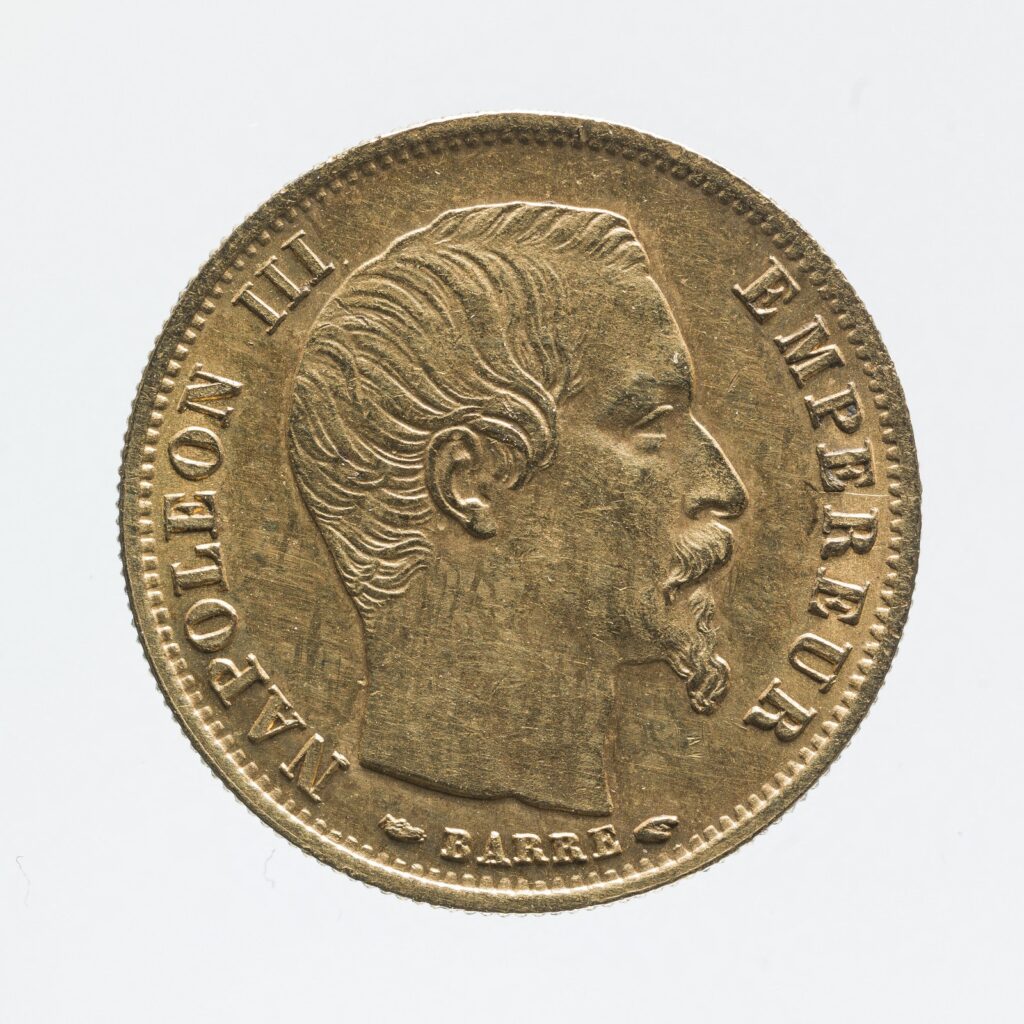
The ‘demi-napoléon’ — France’s 10-franc gold piece struck to the unchanging Franc Germinal standard (3.2258 g, .900 fine, 19 mm) from 1850 to 1914, through the Second Republic, Napoléon III and the Third Republic.
History
- The 10-franc gold piece was introduced in 1850 under the Second Republic with the Cérès type by Louis Merley, struck only in Paris (French Wikipedia, accessed 2026-09-28)
- Under Napoléon III it first appeared in 1854 in ‘petit module’ (about 17.2 mm) with a bare-headed portrait, then in 1855 at the full 19 mm ‘grand module’; many small-module pieces were melted during the changeover, making them rare (French Wikipedia; SilverGoldToBuy, accessed 2026-09-28)
- The portrait engravers were father and son: Jean-Jacques Barre (tête nue, 1854–1860) and Désiré-Albert Barre (tête laurée, 1861–1868); the laureate wreath symbolized imperial and military glory (French Wikipedia; GoldBroker, accessed 2026-09-28)
- The coin was struck to the Franc Germinal standard created by the monetary ordinance of 28 March 1803 under First Consul Bonaparte — 3.2258 g at .900 fine — a specification that never changed across all types (Wikipedia; NGC, accessed 2026-09-28)
- In 1865 France founded the Latin Monetary Union with Belgium, Switzerland and Italy, harmonizing gold coinage on the Napoléon standard — ‘the euro before the euro’ — so the 10-franc piece’s weight and fineness became an international benchmark (Wikipedia; GoldMarket, accessed 2026-09-28)
- After the fall of the Second Empire in 1870, the Third Republic revived the denomination: first the Cérès type (struck sporadically 1878–1899, Paris only), then from 1899 Jules-Clément Chaplain’s Marianne-and-rooster (‘Coq’) type (French Wikipedia, accessed 2026-09-28)
- The Chaplain 10 francs of 1899–1901, 1905–1912 and 1914 bears no mint mark — all were struck at Paris (French Wikipedia, accessed 2026-09-28)
- Regular production ended with World War I; the 1914 Marianne-coq is the last circulating issue (French Wikipedia, accessed 2026-09-28)
- Roughly 23.6 million 10-franc gold pieces were struck between the mid-19th century and 1914, making common dates a deep, liquid bullion market (SilverGoldToBuy, accessed 2026-09-28)
- The coin is nicknamed the ‘demi-napoléon’; it is no longer legal tender in France but is officially classified as investment gold (GoldBroker; Tavex, accessed 2026-09-28)
Key dates and varieties
- 1850–1851-A Cérès (Second Republic) — the very first 10-franc gold issues; Paris-only, two-year type (French Wikipedia, accessed 2026-09-28)
- 1859-BB tête nue (KM 784.4) — mintage just 2,279, the standout rarity of the series (NGC, accessed 2026-09-28)
- 1855-BB tête nue (KM 784.4) — mintage 32,188, scarce Strasbourg issue (NGC, accessed 2026-09-28)
- 1861-A tête laurée (KM 800.1) — first year of the laureate type, mintage 363,000, the lowest of the laureate run (NGC, accessed 2026-09-28)
- 1895-A Cérès (KM 830) — mintage 214,000, lowest of the Third Republic Cérès 10 francs (NGC, accessed 2026-09-28)
- 1862-A ‘petit 10′ variety — laureate type with a small ’10’ in the date, a recognized collectible variety (eMonnaies, accessed 2026-09-28)
Specifications
- Standard (grand module): 19.00 mm, 3.2258 g, .900 fine gold; 0.0933 troy oz actual gold weight (2.903 g pure) (NGC; BullionByPost, accessed 2026-09-28)
- The 1854–55 ‘petit module’ tête nue measures only 17–17.2 mm — a distinct rare type (French Wikipedia, accessed 2026-09-28)
- Edge: reeded; thickness about 0.8 mm (BullionByPost, accessed 2026-09-28)
- Struck to the Franc Germinal standard of 28 March 1803, unchanged across every type (Wikipedia, accessed 2026-09-28)
- Types: Cérès 1850–51 (Second Republic, Merley); Napoléon III tête nue 1854–60 (J.-J. Barre); tête laurée 1861–68 (D.-A. Barre); Cérès 1878–99 (Third Republic); Marianne-coq 1899–1914 (Chaplain) (French Wikipedia; NGC, accessed 2026-09-28)
- Mints: Paris (A) for all types; Strasbourg (BB) for the Napoléon III types only (French Wikipedia, accessed 2026-09-28)
Collector notes
- Mint marks matter: A = Paris, BB = Strasbourg; Strasbourg issues are consistently scarcer than Paris across the Napoleon III types (NGC; French Wikipedia, accessed 2026-09-28)
- Distinguish petit module (17–17.2 mm, 1854–55) from grand module (19 mm) — the small-module tête nue coins are a distinct, rare type, not merely worn examples (French Wikipedia; SilverGoldToBuy, accessed 2026-09-28)
- The Chaplain Marianne-coq type carries no mint mark at all — absence of a letter is normal and confirms Paris (French Wikipedia, accessed 2026-09-28)
- Dealers caution that some historical examples on the market are restrikes — buy attributed, original strikes when paying a numismatic premium (Tavex, accessed 2026-09-28)
- The pictured coin is an 1854 Napoléon III tête nue 10 francs (petit module), Paris mint, photographed from the Musée Carnavalet specimen (Paris Musées, CC0; Wikimedia Commons file page, accessed 2026-09-28)
Market check
Compare live listings for this coin on eBay:
Search eBay for French 10 Francs Napoleon Gold
As an eBay Partner, The Coin Wiki may earn from qualifying purchases.
FREE DOWNLOAD
Before you spend that coin, check it.
The Pocket Change Key-Date Checklist covers the cents, nickels, dimes, quarters and halves still hiding in circulation — including the 1943 and 1983 errors worth five figures. One page to print, a lifetime of jars to check.