
Specifications
- Denomination
- 20 Francs
- Series
- Génie (Angel)
- Designer
- Augustin Dupré
- Engraver
- Augustin Dupré
- Years of issue
- 1848–1849; 1871–1898
- Weight
- 6.4516 g
- Diameter
- 21 mm
- Mint marks
- A (Paris)
- Key mintages
- 1848-A Paris: 1,543,091; ~86 million struck 1871–1898
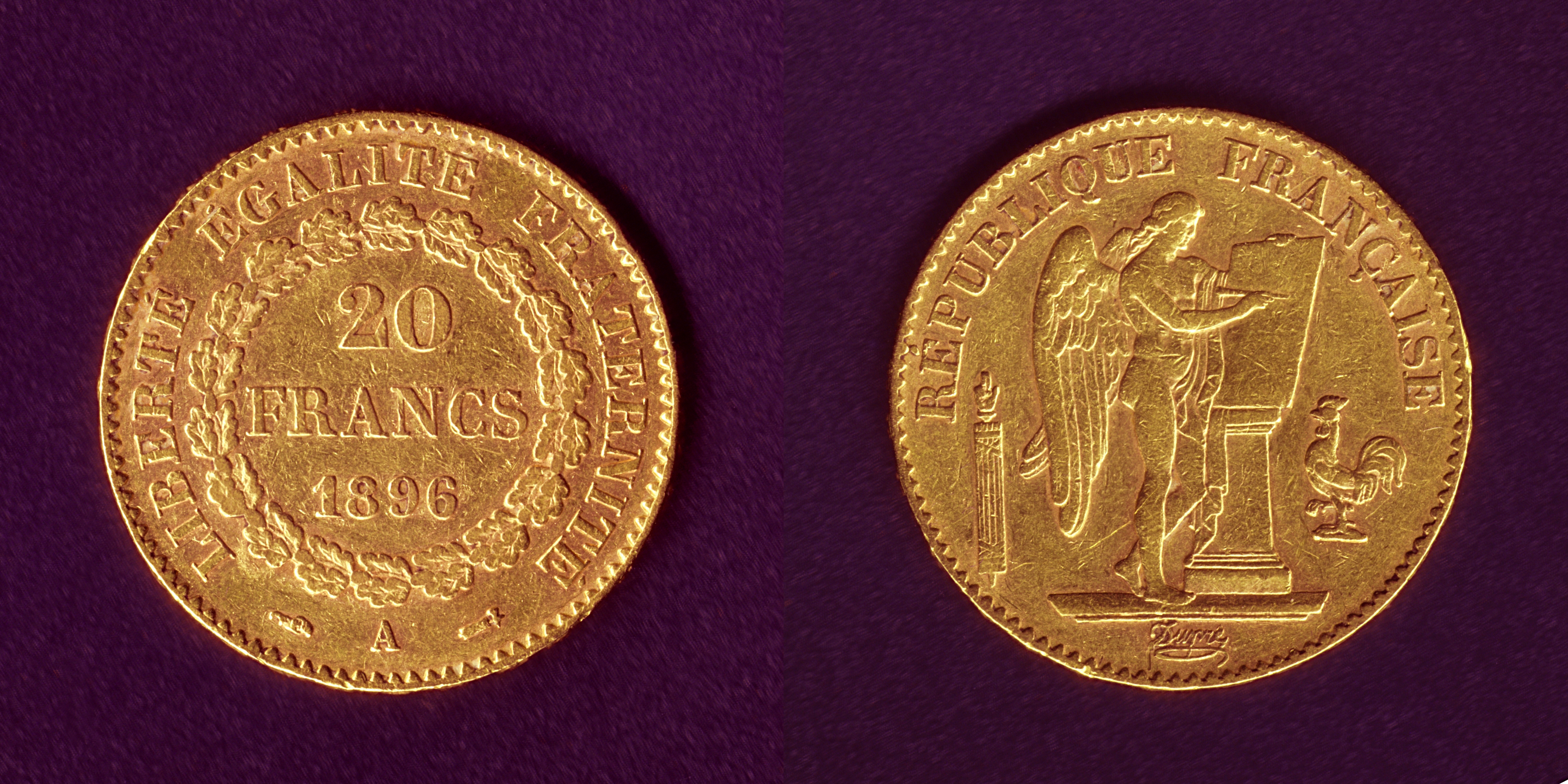
The winged Genius of the Republic by Augustin Dupré on a 6.4516 g, .900 fine gold 20-franc coin — struck 1848–1849 (Second Republic) and 1871–1898 (Third Republic), 21 mm in diameter.
History
- The winged Genius design was conceived in 1791 by engraver Augustin Dupré under the First French Republic, and first appeared on Revolutionary-era gold coinage (the 24-livres Louis XVI type) before the 20-franc issue. (GFI Gold & Forex International, accessed 2026-09-27; JM Bullion, accessed 2026-09-27)
- The design was struck as a gold 20-franc coin for the first time in 1848 and 1849 under the Second Republic, replacing the royal portrait coinage. (GFI Gold & Forex International, accessed 2026-09-27)
- On the first 1848 Paris (A) issue the Genius inscribes ’24-25 FÉV 1848′ on the tablet instead of ‘CONSTITUTION’; 1,543,091 examples were struck at Paris. (Wikimedia Commons file description, accessed 2026-09-27)
- Production was interrupted during the reign of Napoleon III (the Second Empire used the Napoleon-head 20 francs) and resumed after the fall of the Empire. (GFI Gold & Forex International, accessed 2026-09-27)
- The Third Republic reissued the Génie from 1871 to help finance France’s war debts after defeat in the Franco-Prussian War — a clean break with the imperial era and a celebration of the Republic’s values. (GoldBroker.com, accessed 2026-09-27)
- Roughly 86 million Génie 20-franc coins were issued between 1871 and 1898, making it one of the most widely held historic gold coins in the world. (GoldBroker.com, accessed 2026-09-27)
- The Génie type was replaced in 1899 by the Marianne Rooster (‘Coq’) 20-franc design. (GFI Gold & Forex International, accessed 2026-09-27)
- The obverse iconography: the angel with wings spread stands on a cippus writing the Constitution on a stele, a rooster (France’s national symbol) to the right, a lictor’s fasces behind, with the engraver’s signature ‘Dupré’ at the bottom. (GoldBroker.com, accessed 2026-09-27)
- The edge is lettered ‘DIEU PROTÈGE LA FRANCE’ (‘God protects France’) — a holdover from the era before the separation of Church and State. (GoldBroker.com, accessed 2026-09-27)
- The ‘Lucky Angel’ lore: Dupré is said to have bribed his way off the guillotine with an angel coin, and Napoleon supposedly carried one until losing it the night before Waterloo. These are legends, not history — but they drive collector demand. (USAGOLD, accessed 2026-09-27)
Key dates and varieties
- 1848-A Second Republic first-year issue (KM 757; Gadoury 1032; Le Franc F-528) — Heritage lists the issue at 442,000 for this two-year type. (Heritage Auctions, accessed 2026-09-27)
- The 1848 Second Republic issue with ’24-25 FÉV 1848′ on the tablet is the distinctive first striking and a one-year variety. (Wikimedia Commons file description, accessed 2026-09-27)
- Second Republic issues (1848–1849) command clear premiums: current dealer asks run ~£1,029–1,039 for 1848/1849 dates versus ~£722–779 for common 1890s Third Republic dates. (BullionByPost, accessed 2026-09-27)
- 1871-A is the first year of the Third Republic revival after Napoleon III’s fall. (GFI Gold & Forex International, accessed 2026-09-27)
- 1898 is the final year of the Génie type before the Rooster replaced it in 1899. (GFI Gold & Forex International, accessed 2026-09-27)
Specifications
- Weight 6.4516 g, fineness 900 (.900 fine gold), yielding 5.806 g of pure gold — 0.1867 oz AGW. (Heritage Auctions, accessed 2026-09-27; BullionByPost, accessed 2026-09-27)
- Diameter 21 mm. (BullionByPost, accessed 2026-09-27)
- Edge lettered ‘DIEU PROTÈGE LA FRANCE’ (God protects France). (GoldBroker.com, accessed 2026-09-27)
- Mintmark A = Paris; all Génie 20-franc issues were struck at the Paris Mint. (BullionByPost, accessed 2026-09-27; JM Bullion, accessed 2026-09-27)
- Obverse: the winged Genius of the Republic standing, writing the Constitution on a tablet, fasces and rooster, legend ‘RÉPUBLIQUE FRANÇAISE’, signature ‘DUPRÉ’. (GoldBroker.com, accessed 2026-09-27; BullionByPost, accessed 2026-09-27)
- Reverse: ’20 FRANCS’ with date in the center of an oak-and-olive wreath, national motto ‘LIBERTÉ ÉGALITÉ FRATERNITÉ’ around. (BullionByPost, accessed 2026-09-27; GoldBroker.com, accessed 2026-09-27)
- Krause references: KM 757 (Second Republic 1848–1849), KM 825 (Third Republic 1871–1898); Gadoury 1032 / Le Franc F-528 for the 1848 issue. (Heritage Auctions, accessed 2026-09-27; MA-Shops, accessed 2026-09-27)
- Total output around 86 million pieces across 1871–1898. (GoldBroker.com, accessed 2026-09-27)
Collector notes
- The ‘Lucky Angel’ reputation makes this one of the most eagerly held historic gold coins in the world — expect a small premium over melt on all but the most common dates. (USAGOLD, accessed 2026-09-27)
- Identify the type by the angel: unlike the Napoleon-head and Marianne-Rooster 20-franc types, the Génie has no ruler’s portrait on the obverse. (BullionByPost, accessed 2026-09-27)
- The coin qualifies as EU ‘investment gold’ and is exempt from import VAT under Article 344(1)(2) of Council Directive 2006/112/EC. (Heritage Auctions, accessed 2026-09-27)
- At 0.1867 oz fine gold it shares the Latin Monetary Union standard with every other 20-franc gold piece, so cross-type melt comparisons are straightforward. (Heritage Auctions, accessed 2026-09-27)
Market check
Compare live listings for this coin on eBay:
Search eBay for French 20 Francs Gold "Angel" (Génie)
As an eBay Partner, The Coin Wiki may earn from qualifying purchases.
FREE DOWNLOAD
Before you spend that coin, check it.
The Pocket Change Key-Date Checklist covers the cents, nickels, dimes, quarters and halves still hiding in circulation — including the 1943 and 1983 errors worth five figures. One page to print, a lifetime of jars to check.