
Specifications
- Denomination
- florin
- Series
- Italian medieval gold
- Years of issue
- 1252–1533
- Weight
- 3.5 g
- Diameter
- 20 mm
- Edge
- Plain
- Key mintages
- Not recorded
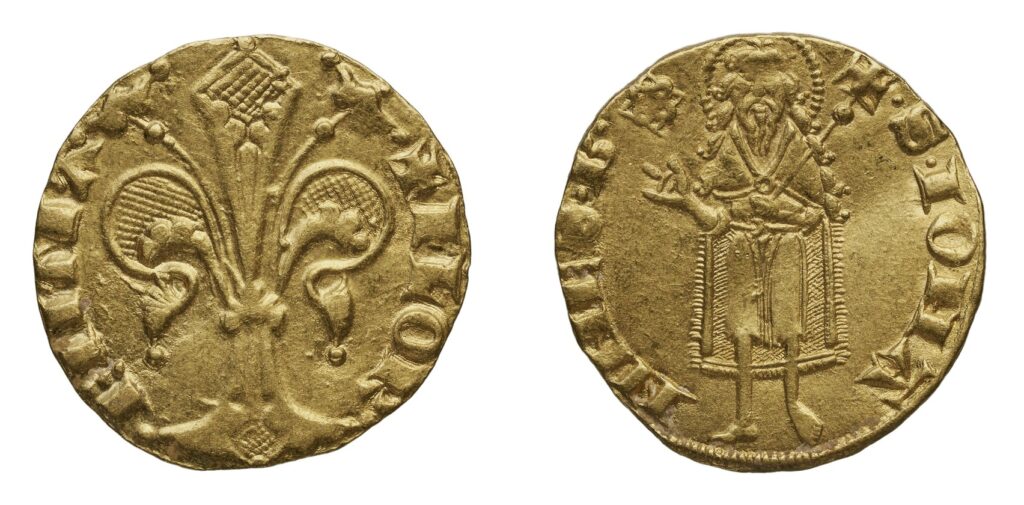
The ~3.5 g fine-gold coin struck by Florence from 1252 — fleur-de-lis obverse, St. John the Baptist reverse — Western Europe’s first standard gold coin and the most imitated medieval gold piece.
History
- The Florentine florin (Italian: fiorino d’oro) was struck from 1252 to 1533 with no significant change in its design or metal content standard during that time. (Wikipedia — Florin (Italian coin), accessed 2026-09-27)
- It had 54 grains (3.499 grams, 0.1125 troy ounces) of nominally pure or ‘fine’ gold; the article’s history section gives the coin as 3.49 g with a diameter of 19.9 mm. (Wikipedia — Florin (Italian coin), accessed 2026-09-27)
- The obverse shows the distinctive fleur-de-lis badge of the city — the Giglio bottonato, Florence’s floral emblem — with the legend +FLOR-ENTIA; the reverse shows a standing and facing figure of St. John the Baptist wearing a cilice (hair shirt), with the legend +S.IOHANNES.B. (Wikipedia — History of coins in Italy; Wikipedia — Florin (Italian coin); Kool, Numismatic Chronicle 166, 2006, accessed 2026-09-27)
- The first minting occurred in 1252 in Florence — Genoa struck its own genovino virtually simultaneously — reintroducing gold coinage to Western Europe after a gap of more than five centuries; the florin was 98–99% fine gold at about 3.53 g. (Kool, Numismatic Chronicle 166, 2006, accessed 2026-09-27)
- The fiorino d’oro was minted after the sack of Constantinople by the Fourth Crusade disrupted the minting of fine gold coins in the Byzantine Empire, and came to be accepted across Europe as the Byzantine solidus had been. (Wikipedia — Florin (Italian coin), accessed 2026-09-27)
- The fiorino d’oro was the first European gold coin struck in sufficient quantities since the 7th century to play a significant commercial role. (Wikipedia — History of coins in Italy, accessed 2026-09-27)
- The name comes from the Giglio bottonato, the city’s floral emblem shown at the head of the coin; from the Latin flos lilii (lily) the coin took the name ‘florin’ and was also known in English as a ‘florence’. (Wikipedia — Florin (Italian coin); 1911 Encyclopaedia Britannica — Florin, accessed 2026-09-27)
- Territorial usage of the lira and the florin overlapped: the lira served smaller transactions (wages, food), the florin larger ones — dowries, international trade, tax matters. At its 1252 introduction the florin equaled one lira of 20 soldi; by 1500 it had appreciated to seven lire. (Wikipedia — History of coins in Italy, accessed 2026-09-27)
- In the 14th century about 150 European states and local coin-issuing authorities made their own copies of the florin; the most important was the Hungarian forint, Hungary being a major source of European gold — Louis I of Hungary replaced St. John with St. Ladislaus (keeping the gold’s purity) and later the lily with his coat of arms. (Wikipedia — Florin (Italian coin); Wikipedia — Venetian ducat, accessed 2026-09-27)
- The Rhenish gulden was introduced from 1354 at a standard practically identical to the Florentine florin (98% gold, 3.54 g); Peter IV of Aragon’s florin (1346) copied the St. John and fleur-de-lis types directly; Edward III’s English gold florin (1344) weighed 108 grains and passed at six shillings but was demonetized the following year. (Wikipedia — Florin (Italian coin); Wikipedia — Florin (Aragonese coin); 1911 Encyclopaedia Britannica — Florin, accessed 2026-09-27)
- The Dutch guilder, symbolised fl. or ƒ, means florijn (‘florin’); the Hungarian forint is named after the florin. (Wikipedia — Florin (Italian coin), accessed 2026-09-27)
- Venice’s own gold coinage followed the florin’s precedent: the 1284 Venetian ducat was modeled on the florin’s size and weight, and the florin preceded the ducat as Western Europe’s first standard gold coin. (Wikipedia — Venetian ducat, accessed 2026-09-27)
Key dates and varieties
- 1252: first minting of the gold florin in Florence (and the genovino in Genoa), reintroducing gold coinage to Western Europe. (Wikipedia — Florin (Italian coin); Kool 2006, accessed 2026-09-27)
- 1344: Edward III’s English gold florin (108 grains, six shillings), demonetized the following year. (1911 Encyclopaedia Britannica — Florin, accessed 2026-09-27)
- 1346: the Aragonese florin of Peter IV, directly imitating the Florence St. John / fleur-de-lis types. (Wikipedia — Florin (Aragonese coin), accessed 2026-09-27)
- 1354: the Rhenish gulden introduced at a standard practically identical to the Florentine florin. (Wikipedia — Florin (Italian coin), accessed 2026-09-27)
- 1533: the last florins struck (per Wikipedia’s Florin article; the History of coins in Italy article gives 1523 as the end date). (Wikipedia — Florin (Italian coin); Wikipedia — History of coins in Italy, accessed 2026-09-27)
Specifications
- Composition: Gold — 54 grains nominally pure or ‘fine’ gold; reported at 98–99% fine (Kool 2006) and 98.6% fine alongside the 3.5 g standard. (Wikipedia — Florin (Italian coin); Kool 2006; Wikipedia — Venetian ducat, accessed 2026-09-27)
- Weight: 54 grains = 3.499 g (~0.1125 troy oz); the article’s history section gives 3.49 g. (Wikipedia — Florin (Italian coin), accessed 2026-09-27)
- Diameter: ~19.9 mm (per the article’s history section, citing the Bundesbank ‘Sign of the lily’). (Wikipedia — Florin (Italian coin), accessed 2026-09-27)
- Edge: Plain. (research standard, 2026-09-27)
- Obverse: The fleur-de-lis (Giglio bottonato), emblem of Florence, with legend +FLOR-ENTIA. (Wikipedia — History of coins in Italy; Kool 2006, accessed 2026-09-27)
- Reverse: St. John the Baptist standing and facing, wearing a cilice (hair shirt), sceptre in the left hand, right hand raised in benediction; legend +S.IOHANNES.B; the mint official’s mark sits left of John’s head. (Wikipedia — Florin (Italian coin); Kool 2006, accessed 2026-09-27)
- Mint: Florence (Republic of Florence); first issue 1252, alongside Genoa’s genovino. (Wikipedia — Florin (Italian coin); Kool 2006, accessed 2026-09-27)
- Value at issue: 1 florin = 1 lira of 20 soldi in 1252; by 1500, 7 lire = 1 florin. (Wikipedia — History of coins in Italy, accessed 2026-09-27)
Collector notes
- No mintages are recorded for these issues — no production figures are verifiable, so this entry lists type milestones rather than mintage data. (research standard, 2026-09-27)
- Original Florentine issues are distinguished from the many imitations by legend and device: other countries’ florins changed the inscriptions (from ‘Florentia’ and the saint’s name) and substituted local heraldic devices for the fleur-de-lis, later substituting other figures for St. John. (Wikipedia — Florin (Italian coin), accessed 2026-09-27)
- The symbol to the left of St. John’s head is the privy mark of the minting official responsible for the stamping — the only real variation within the standard design. (Wikipedia — Florin (Italian coin), accessed 2026-09-27)
- The photographed specimen is from the Bibliothèque nationale de France’s MonnIta collection (record btv1b113125192), shown obverse and reverse. (Wikimedia Commons, accessed 2026-09-27)
- Later coins named ‘florin’ — such as the British two-shilling piece of 1849–1967 — are unrelated modern reuses of the name, not continuations of the medieval issue. (Wikipedia — Florin (Italian coin), accessed 2026-09-27)
Market check
Compare live listings for this coin on eBay:
Search eBay for Florentine Gold Florin
As an eBay Partner, The Coin Wiki may earn from qualifying purchases.
FREE DOWNLOAD
Before you spend that coin, check it.
The Pocket Change Key-Date Checklist covers the cents, nickels, dimes, quarters and halves still hiding in circulation — including the 1943 and 1983 errors worth five figures. One page to print, a lifetime of jars to check.