
Specifications
- Denomination
- 8 escudos
- Series
- Spanish colonial gold — doubloons
- Weight
- 27.07 g
- Key mintages
- Not recorded for cobs; colonial gold mintages are poorly documented overall — no mintage figures are verifiable for the cob era.
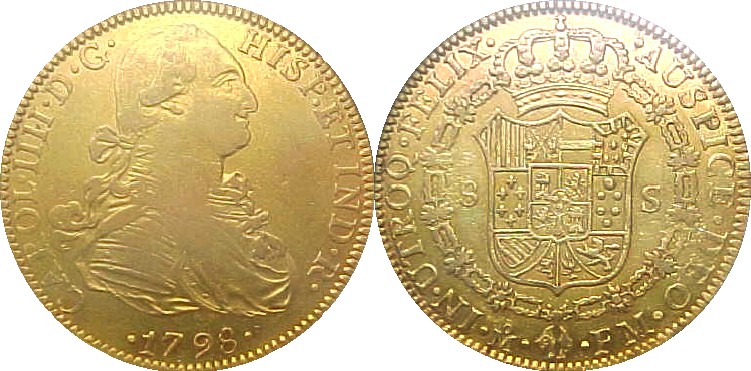
The gold 8-escudos piece — about 27.07 g of 22-karat gold — called the “doubloon” in English usage, struck as irregular hammered cobs from the 1500s and as milled portrait coins from 1772.
History
- The 8 escudos was the largest standard Spanish gold denomination: about 27.07 g at 0.9170 fine (22 karat), roughly 0.7981 troy oz of pure gold. (NGC price guide, Spain 8 Escudos KM 346.2, accessed 2026-09-27)
- In English usage the 8-escudo piece was itself called the “doubloon” — the “doubloon of eight” or “quadruple pistole,” worth about $16 in the colonies. Strictly in Spanish, doblon meant the smaller 2-escudo piece (~6.77 g, worth about $4), so the nomenclature is confusing and sources must be checked. (Wikipedia — Doubloon, accessed 2026-09-27)
- Each escudo was worth around two Spanish dollars (8 reales), making the 8 escudos the gold counterpart of the pillar dollar / piece of eight. (Wikipedia — Doubloon, accessed 2026-09-27)
- From the 1500s to the mid-1700s, colonial gold was struck as cobs (Spanish: macuquinas): blanks sliced from bars and hammer-struck, accurate in weight but irregular in shape — sometimes clipped at the mint to reach the correct weight. Gold cobs were produced at the major colonial mints: Mexico City, Lima, Potosi, Santa Fe de Bogota and others. (Wikipedia — Spanish colonial real; Numismatic News — Bolivian Heart Cobs, accessed 2026-09-27)
- In the 18th century, ordinances under Philip V made machine striking mandatory — perfectly round coins with reeded/milled edges — replacing the hammered cobs over time. (forumancientcoins.com summary of Spanish colonial coinage, accessed 2026-09-27)
- From 1772 the 8 escudos was struck as a milled portrait (bust) coin: the reigning monarch’s bust on the obverse and the crowned Spanish arms on the reverse. Spain’s Seville and Madrid mints issued bust-type 8 escudos 1772–1784, and the colonial mints struck portrait gold under Charles III’s ordinances. (coinscatalog.NET — Spain 8 Escudos 1775; forumancientcoins.com summary of Spanish colonial coinage, accessed 2026-09-27)
- The 1715 Treasure Fleet — a convoy of Spanish galleons wrecked in a hurricane off the Florida coast in 1715 — scattered thousands of gold cobs and milled gold coins, including Mexico City and Lima 8 escudos, recovered from the seabed centuries later; they are the archetypal pirate-treasure coins. (Pirate Gold Coins — 1715 Fleet product descriptions, accessed 2026-09-27)
- The modern “pirate doubloon” image comes largely from historical fiction about piracy, in which gold coins were prime booty. (Wikipedia — Doubloon, accessed 2026-09-27)
- After independence, the former viceroyalties (Mexico, Peru, New Granada) kept minting doubloons/8 escudos to the old standards through the 19th century. (Wikipedia — Doubloon, accessed 2026-09-27)
Key dates and varieties
- 1500s–mid-1700s: cob era — irregular hammer-struck 8 escudos at the colonial mints; mintages were not recorded. (Wikipedia — Spanish colonial real; Numismatic News — Bolivian Heart Cobs, accessed 2026-09-27)
- 1715: the 1715 Treasure Fleet wreck — gold 8-escudos cobs (Mexico City, Lima) lost in a hurricane off Florida and recovered centuries later. (Pirate Gold Coins, accessed 2026-09-27)
- 1730s: milled (screw-press) coinage ordered for the colonial mints under Philip V’s ordinances; round coins with reeded edges gradually replace cobs. (forumancientcoins.com summary of Spanish colonial coinage, accessed 2026-09-27)
- 1772: first milled portrait (bust) 8 escudos — the monarch’s bust obverse / crowned arms reverse, in Spain and the colonies under Charles III’s ordinances. (coinscatalog.NET — Spain 8 Escudos 1775; forumancientcoins.com summary, accessed 2026-09-27)
- 1820s onward: newly independent Mexico, Peru and New Granada (Colombia) continue striking 8 escudos after the fall of Spanish rule. (Wikipedia — Doubloon, accessed 2026-09-27)
Specifications
- Composition: Gold, 0.9170 fine (22 karat) — NGC price guide, Spain 8 Escudos KM 346.2, accessed 2026-09-27
- Weight: ~27.07 g; ~0.7981 troy oz AGW — NGC price guide, Spain 8 Escudos KM 346.2, accessed 2026-09-27
- Denomination: 8 escudos — the “doubloon of eight” / “quadruple pistole” in English usage; strictly the Spanish doblon was the 2-escudo piece. (Wikipedia — Doubloon, accessed 2026-09-27)
- Colonial value: About $16 — each escudo worth around two Spanish dollars (16 reales of silver). (Wikipedia — Doubloon, accessed 2026-09-27)
- Mints: Mexico City, Lima, Potosi, Santa Fe de Bogota, Guatemala, Santiago, Popayan, Seville, Madrid. (forumancientcoins.com summary of Spanish colonial coinage, accessed 2026-09-27)
- Types: Hammered cob (macuquina), 1500s–mid-1700s; milled cross/pillar gold, 1700s; milled portrait (bust), 1772 onward. (forumancientcoins.com summary; coinscatalog.NET, accessed 2026-09-27)
- Edge: Milled/reeded on the machine-struck portrait issues. (forumancientcoins.com summary of Spanish colonial coinage, accessed 2026-09-27)
Collector notes
- Cob mintages were not recorded in the surviving colonial mint records, so no mintage figures appear for the cob era; NGC’s price-guide mintage columns for these issues are blank. (NGC price guide, Spain 8 Escudos KM 346.2, accessed 2026-09-27)
- Do not confuse the strict Spanish doblon (2 escudos, 6.77 g, ~$4) with the English-usage “doubloon” (8 escudos, ~27.07 g, ~$16) — many catalog descriptions mix them. (Wikipedia — Doubloon, accessed 2026-09-27)
- Shipwreck-provenance 8 escudos (1715 Fleet) carry large premiums over melt and are sold certified (NGC/PCGS); gold-plated replica pendants modeled on the same coins are sold as jewelry, so buy shipwreck coins authenticated. (Pirate Gold Coins — 1715 Fleet product descriptions, accessed 2026-09-27)
Market check
Compare live listings for this coin on eBay:
Search eBay for Spanish 8 Escudos "Doubloon"
As an eBay Partner, The Coin Wiki may earn from qualifying purchases.
FREE DOWNLOAD
Before you spend that coin, check it.
The Pocket Change Key-Date Checklist covers the cents, nickels, dimes, quarters and halves still hiding in circulation — including the 1943 and 1983 errors worth five figures. One page to print, a lifetime of jars to check.