
Specifications
- Denomination
- 50 yen
- Series
- Japanese yen — circulating coinage
- Years of issue
- 1967–present
- Composition
- 75% Copper, 25% Nickel
- Weight
- 4 g
- Diameter
- 21 mm
- Edge
- Reeded
- KM
- Y#81
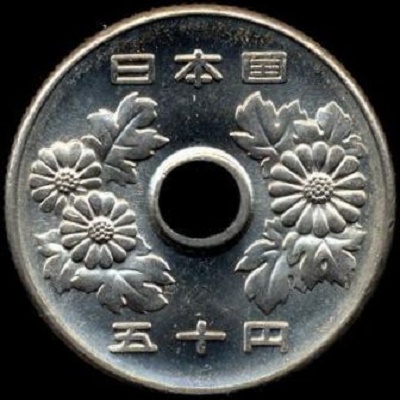
Japan’s holed 50 yen coin has been struck in cupronickel (75% copper, 25% nickel) since 1967 (Showa 42): 4.0 g, 21.0 mm, with a 4 mm center hole, chrysanthemums on the obverse and a large “50” on the reverse. It is still issued today and remains full legal tender.
History
- Introduced in 1967 (Showa 42), replacing the larger 25.0 mm pure-nickel holed 50 yen of 1959–1966, which had itself replaced a solid 25.0 mm nickel 50 yen of 1955–1958. (Ministry of Finance)
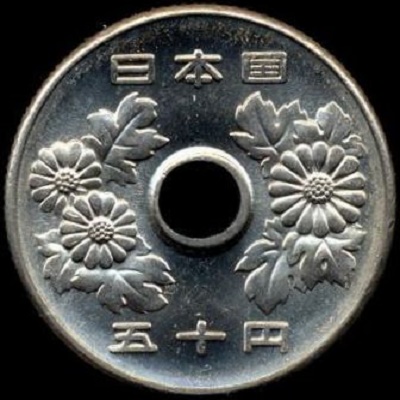
- Obverse: chrysanthemum (菊花) around the center hole with 日本国 (Japan) at top and 五十円 (50 yen) below; reverse: large numeral “50” above the hole with the nengo date below. (Ministry of Finance; NGC)
- Struck every calendar year from 1967 through 2024, spanning three imperial eras — Showa 42–64, Heisei 1–31, Reiwa 1–6 — and never demonetized; the Ministry of Finance lists it as “currently issued.” (Japan Mint; Ministry of Finance)
- One of only two holed coins in the current Japanese series (the other is the brass 5 yen), with a reeded edge and a 4 mm center hole. (Japan Mint)
- The key Showa date is Showa 62 (1987): the Mint’s production table shows 775,000 struck (NGC/NumisMaster lists 545,000 for the circulation strike — catalog figures differ, but both agree it is the series’ lowest Showa mintage). (Japan Mint; NGC)
- Production collapsed to mint-set levels in the 2010s–2020s: the all-time low is 2023 (Reiwa 5) at 463,000; other sub-million years include 2010 (Heisei 22, 510,000), 2011 (Heisei 23, 456,000), 2012 (Heisei 24, 659,000), 2013 (Heisei 25, 554,000), 2022 (Reiwa 4, 574,000) and 2024 (Reiwa 6, 511,000). (Japan Mint)
- Japan uses no mint marks; circulation 50 yen coins are struck by the Japan Mint (Osaka). (Numista)
Key dates and varieties
- Showa 62 (1987): 775,000 — lowest Showa mintage (NGC lists 545,000; discrepancy noted in history)
- Heisei 13 (2001): 8,024,000
- Heisei 14 (2002): 11,667,000
- Reiwa 3 (2021): 9,133,000
- Heisei 22 (2010): 510,000 — Heisei 23 (2011): 456,000 — Heisei 24 (2012): 659,000 — Heisei 25 (2013): 554,000 (sub-million years)
- Reiwa 4 (2022): 574,000 — Reiwa 5 (2023): 463,000 (series low) — Reiwa 6 (2024): 511,000
- Reference: first year Showa 42 (1967): 238,400,000
- All figures: Japan Mint annual production, calendar year, thousands of pieces, commemoratives excluded, rounded.
Specifications
- Denomination: 50 yen — Years: 1967–present (Showa 42 – Reiwa 7)
- Composition: Cupronickel — copper 75%, nickel 25% (Cu 750 / Ni 250 per mille). (Japan Mint)
- Weight: 4.0 g — Diameter: 21.0 mm — Center hole: 4.0 mm. (Japan Mint)
- Edge: Reeded. (NGC)
- Mint marks: None — no mint marks used. (Japan Mint)
- Catalog: Y#81. (NGC)
Collector notes
- Distinguish from the 1959–1966 pure-nickel holed 50 yen: that type is larger (25.0 mm), heavier (5.0 g), pure nickel, and shows the chrysanthemum “seen from directly above”; the 1967+ cupronickel type is 21.0 mm. (Ministry of Finance)
- Read the date on the reverse under the “50” — it is a nengo date (e.g. 昭和六十二年 = Showa 62 = 1987). 1989 coins exist as both Showa 64 and Heisei 1; 2019 coins exist as Heisei 31 (1,118,000 struck) and Reiwa 1. (Japan Mint)
- Pull recent-year coins (2010–2013, 2021–2024) from circulation — genuine sub-million mintages, not errors. (Japan Mint)
- No mint marks exist on any Japanese circulating coin; “Osaka” attributions in catalogs refer to the Japan Mint’s Osaka facility.
- Still legal tender and still being issued — the Ministry of Finance lists it under “Currently Issued,” so there is no demonetization premium. (Ministry of Finance)
Market check
Recent eBay sales

Confirmed realized sales only — our monitor records a sale when a live eBay listing’s available quantity drops. Never asking prices.
Compare live listings for this coin on eBay:
Search eBay for Japan 50 Yen Cupronickel
As an eBay Partner, The Coin Wiki may earn from qualifying purchases.
FREE DOWNLOAD
Before you spend that coin, check it.
The Pocket Change Key-Date Checklist covers the cents, nickels, dimes, quarters and halves still hiding in circulation — including the 1943 and 1983 errors worth five figures. One page to print, a lifetime of jars to check.