
Specifications
- Denomination
- 5 yen
- Series
- Japanese yen — circulating coinage
- Years of issue
- 1949–present
- Weight
- 3.75 g
- Diameter
- 22 mm
- Edge
- Plain
- Key mintages
- Japan Mint annual production (calendar year, rounded, commemoratives excluded). Old-script (Y#72) keys: 1957: 10,000,000; 1958: 50,000,000; none struck 1954–1956. New-font (Y#72a) begins 1959: 33,000,000.
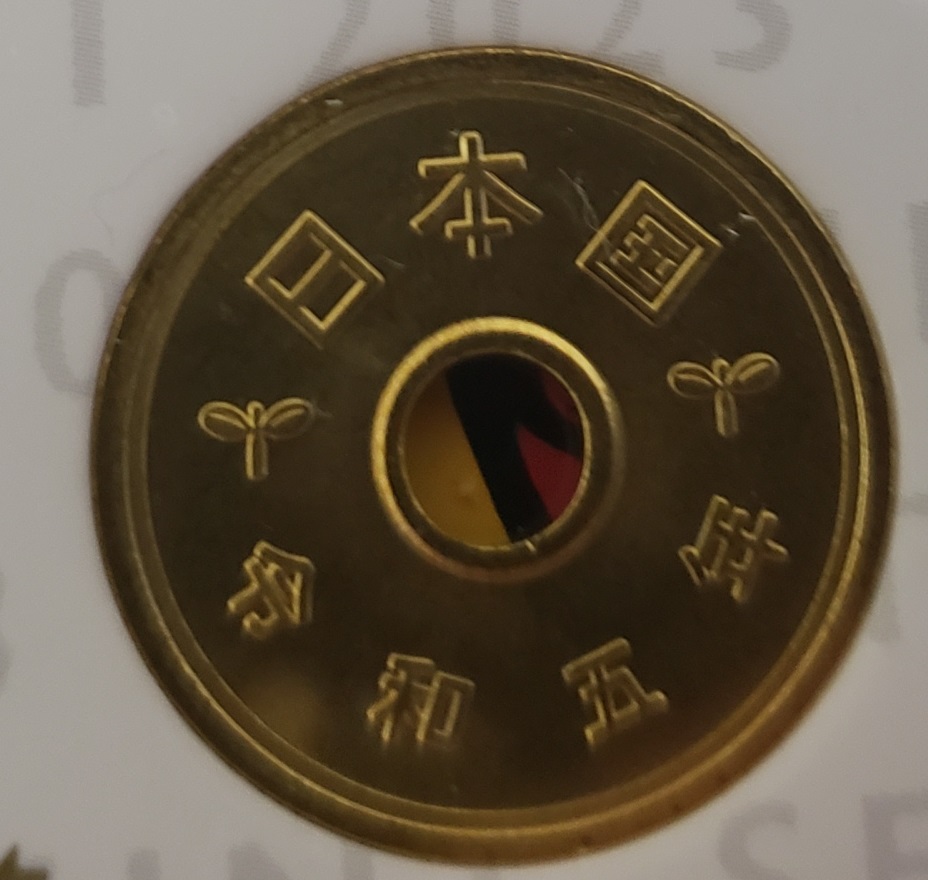
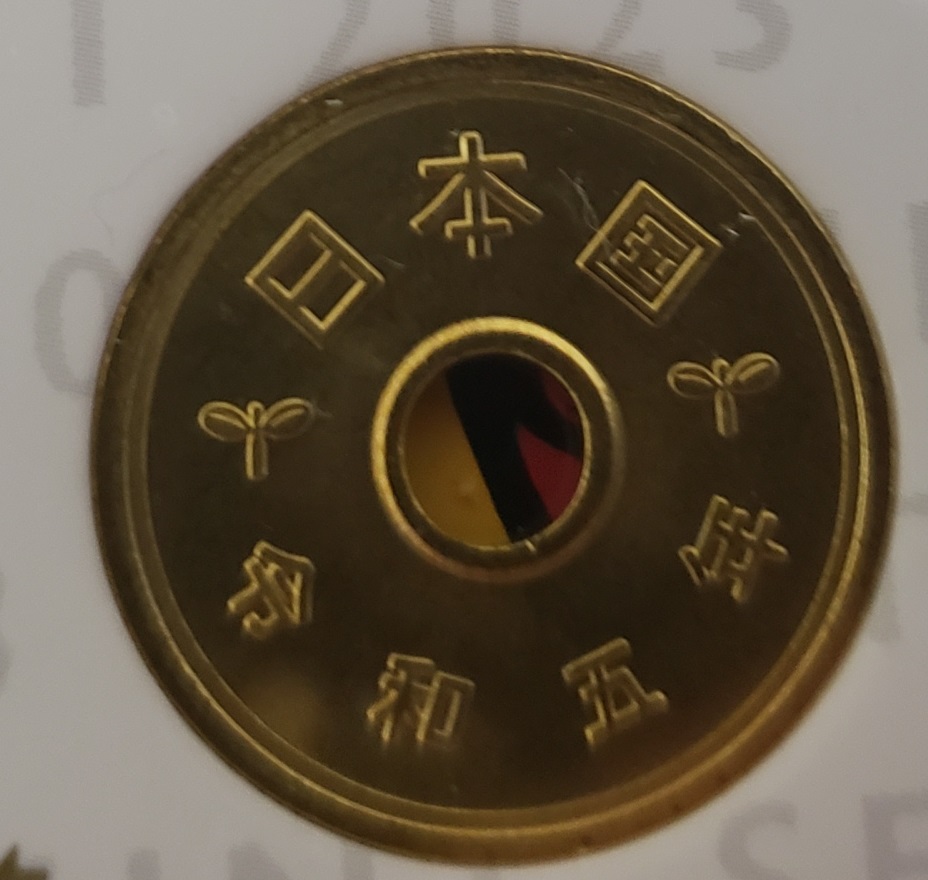
Japan’s holed 5 yen brass coin has circulated since 1949 (Showa 24): rice, gear, and waves symbolizing agriculture, industry, and fisheries at 3.75 g and 22.0 mm — the only current Japanese coin whose value is not written in Arabic numerals.
History
- The holed brass 5 yen was first issued in 1949 (Showa 24), replacing an unholed brass 5 yen of 1948–1949 (Y#71, 4 g, reeded) that was easily confused with the similar brass 1 yen; the hole also saved metal. (Japan Mint; Numista; Japan Mint pierced-coin essay)
- The 1949–1958 type used kaisho (brush-style) script — nicknamed “fudego” (brush five) — with the old-form 國 on the reverse (Y#72). (ZenPlus; NGC)
- In 1959 (Showa 34) the lettering changed to the current gothic font (Y#72a); both the old and new types remain legal tender. (Japan Mint; Ministry of Finance)
- Obverse: rice plant (agriculture), gear around the hole (heavy industry), horizontal stripes (fisheries); reverse: young leaves symbolizing postwar democratic rebirth — the only current Japanese coin without Arabic numerals. (Japan Mint)
- Brass of copper 60–70% and zinc 30–40% (official range; no exact alloy published); 3.75 g, 22.0 mm, 5 mm center hole, plain edge, medal alignment. (Japan Mint; Numista)
- Low old-script mintages: 1957 at 10,000,000 and 1958 at 50,000,000; no 5 yen coins were struck 1954–1956. (Japan Mint; NGC)
- “Five yen” (go-en) puns on “auspicious connection,” making the 5 yen Japan’s traditional shrine and temple offering. (SoraNews24)
Key dates and varieties
- 1949 (Showa 24): first holed year — 111,896,000 struck. (Japan Mint; NGC)
- Old-script (kaisho/fudego) keys: 1957: 10,000,000; 1958: 50,000,000; none struck 1954–1956. Full old-script run: 1950: 181,824,000; 1951: 197,980,000; 1952: 55,000,000; 1953: 45,000,000. (Japan Mint; NGC)
- 1959 (Showa 34): new gothic font begins — 33,000,000 struck. (Japan Mint)
- Pre-type: unholed brass 5 yen, 1948–1949 (Showa 23–24), Y#71 / N#5940, 4 g, 22 mm, reeded edge, pigeon / Diet building design. (Numista)
- All figures: Japan Mint annual production, calendar year, rounded, commemoratives excluded.
Specifications
- Denomination: 5 yen — Years: 1949–present (Showa 24 – Reiwa 8)
- Composition: Brass — copper 60–70%, zinc 30–40% (official range; the Japan Mint publishes no exact alloy). (Japan Mint; Numista)
- Weight: 3.75 g — Diameter: 22.0 mm — Thickness: 1.5 mm — Center hole: 5 mm. (Japan Mint; Numista)
- Edge: Plain. (Numista)
- Mint marks: None — no mint marks used. (Numista)
- Catalog: Y#72 (Showa kaisho, N#97765, JNDA# 02-11); Y#72a (Showa gothic, N#929, JNDA# 02-12); Y#96 (Heisei, N#2676); Y#284 (Reiwa, N#182977). (Numista)
Collector notes
- The only current Japanese coin without Arabic numerals — the value reads 五円, so learn the kanji, not the digit. (Japan Mint)
- Old vs new script: kaisho “brush-style” lettering with old-form 國 = 1949–1958 (Y#72, “fudego”); gothic lettering = 1959–present (Y#72a and later). (Numista; ZenPlus)
- Don’t confuse the holed type with the unholed brass 5 yen of 1948–1949 (Y#71, 4 g, reeded edge, pigeon/Diet building design) — a different, scarcer coin. (Numista)
- The center hole is original to the design, not damage — added in 1949 partly to save metal and to distinguish the coin from the brass 1 yen. (Japan Mint; Japan Mint pierced-coin essay)
- Go-en wordplay (“five yen” ≈ “auspicious connection”) makes the 5 yen Japan’s classic shrine offering — circulated examples are common, so hold out for lustrous ones. (SoraNews24)
Market check
Recent eBay sales

Confirmed realized sales only — our monitor records a sale when a live eBay listing’s available quantity drops. Never asking prices.
Compare live listings for this coin on eBay:
Search eBay for Japan 5 Yen Brass
As an eBay Partner, The Coin Wiki may earn from qualifying purchases.
FREE DOWNLOAD
Before you spend that coin, check it.
The Pocket Change Key-Date Checklist covers the cents, nickels, dimes, quarters and halves still hiding in circulation — including the 1943 and 1983 errors worth five figures. One page to print, a lifetime of jars to check.