
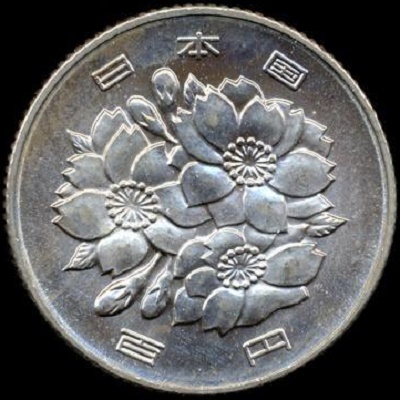
Specifications
- Denomination
- 100 yen
- Series
- Japanese yen — circulating coinage
- Years of issue
- 1967–present
- Composition
- 75% Copper, 25% Nickel
- Weight
- 4.8 g
- Diameter
- 22.6 mm
- Edge
- Reeded
- KM
- Y#82
- Key mintages
- Japan Mint annual production (calendar year, rounded, commemoratives excluded). Key low years — Heisei 13 (2001): 8,024,000 (series low); Heisei 14 (2002): 10,667,000; Showa 59 (1984): 41,850,000; Showa 58 (1983): 50,000,000; Showa 60 (1985): 58,150,000. First year Showa 42 (1967): 432,200,000.
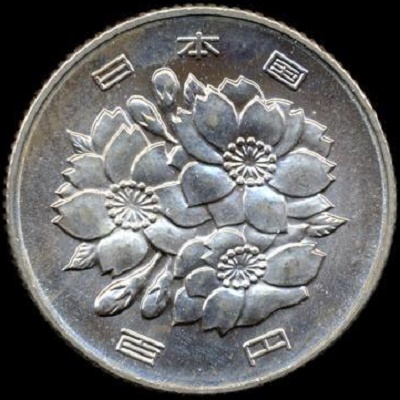
Japan’s 100 yen coin has carried cherry blossoms on its obverse since the cupronickel type debuted in 1967 (Showa 42): 4.8 g, 22.6 mm, reeded edge, 75% copper / 25% nickel. It is the workhorse of Japanese daily commerce and remains in production today.
History
- Introduced in 1967 (Showa 42), replacing the silver 100 yen — the rice-plant design (60% silver, 1959–1966) and the earlier phoenix design (1957–1958). (Ministry of Finance)
- Obverse: cherry blossoms (桜花) with 日本国 (Japan) above and 百円 (100 yen) below; reverse: large “100” in the center with the nengo date below. (Ministry of Finance; Numista)
- Struck every calendar year 1967–2024 across Showa 42–64, Heisei 1–31 and Reiwa 1–6; listed by the Ministry of Finance as “currently issued” — never demonetized. (Japan Mint; Ministry of Finance)
- Medal alignment, reeded edge, struck at the Japan Mint (Osaka); no mint marks. (Numista)
- The series’ lowest mintages are Heisei 13 (2001) at 8,024,000 and Heisei 14 (2002) at 10,667,000 — both far below any Showa year. (Japan Mint)
- Other notably low years: Showa 58 (1983) 50,000,000; Showa 59 (1984) 41,850,000; Showa 60 (1985) 58,150,000; Heisei 22 (2010) 67,905,000; Heisei 5 (1993) 82,240,000; Heisei 6 (1994) 81,767,000; Heisei 7 (1995) 92,874,000; Heisei 20 (2008) 93,811,000. (Japan Mint)
Key dates and varieties
- Heisei 13 (2001): 8,024,000 — series low
- Heisei 14 (2002): 10,667,000
- Showa 59 (1984): 41,850,000 — Showa 58 (1983): 50,000,000 — Showa 60 (1985): 58,150,000
- Heisei 22 (2010): 67,905,000 — Heisei 6 (1994): 81,767,000 — Heisei 5 (1993): 82,240,000 — Heisei 7 (1995): 92,874,000 — Heisei 20 (2008): 93,811,000
- Reference: first year Showa 42 (1967): 432,200,000
- All figures: Japan Mint annual production, calendar year, thousands of pieces, commemoratives excluded, rounded.
Specifications
- Denomination: 100 yen — Years: 1967–present (Showa 42 – Reiwa 7)
- Composition: Cupronickel — copper 75%, nickel 25% (Cu 750 / Ni 250 per mille). (Japan Mint)
- Weight: 4.8 g — Diameter: 22.6 mm. (Japan Mint)
- Edge: Reeded. (Numista)
- Mint marks: None — no mint marks used.
- Catalog: Y#82; Numista N#1589; JNDA# 02-4. (Numista)
Collector notes
- Distinguish from the 1959–1966 silver 100 yen (rice design, 60% silver): same 22.6 mm diameter and 4.8 g weight, so check the date — Showa 34–41 (1959–1966) is silver and worth more than face; Showa 42+ is cupronickel. (Ministry of Finance)
- The date sits on the reverse under the “100” as a nengo date (e.g. 昭和47年 = Showa 47 = 1972). (Numista)
- Heisei 13 (2001) is the key date of the cupronickel type at just over 8 million — worth pulling from circulation in high grade. (Japan Mint)
- No mint marks; catalogs attribute production to the Japan Mint, Osaka.
- Still legal tender and still minted — no demonetization premium. (Ministry of Finance)
Market check
Recent eBay sales

Confirmed realized sales only — our monitor records a sale when a live eBay listing’s available quantity drops. Never asking prices.
Compare live listings for this coin on eBay:
Search eBay for Japan 100 Yen Cupronickel
As an eBay Partner, The Coin Wiki may earn from qualifying purchases.
FREE DOWNLOAD
Before you spend that coin, check it.
The Pocket Change Key-Date Checklist covers the cents, nickels, dimes, quarters and halves still hiding in circulation — including the 1943 and 1983 errors worth five figures. One page to print, a lifetime of jars to check.