
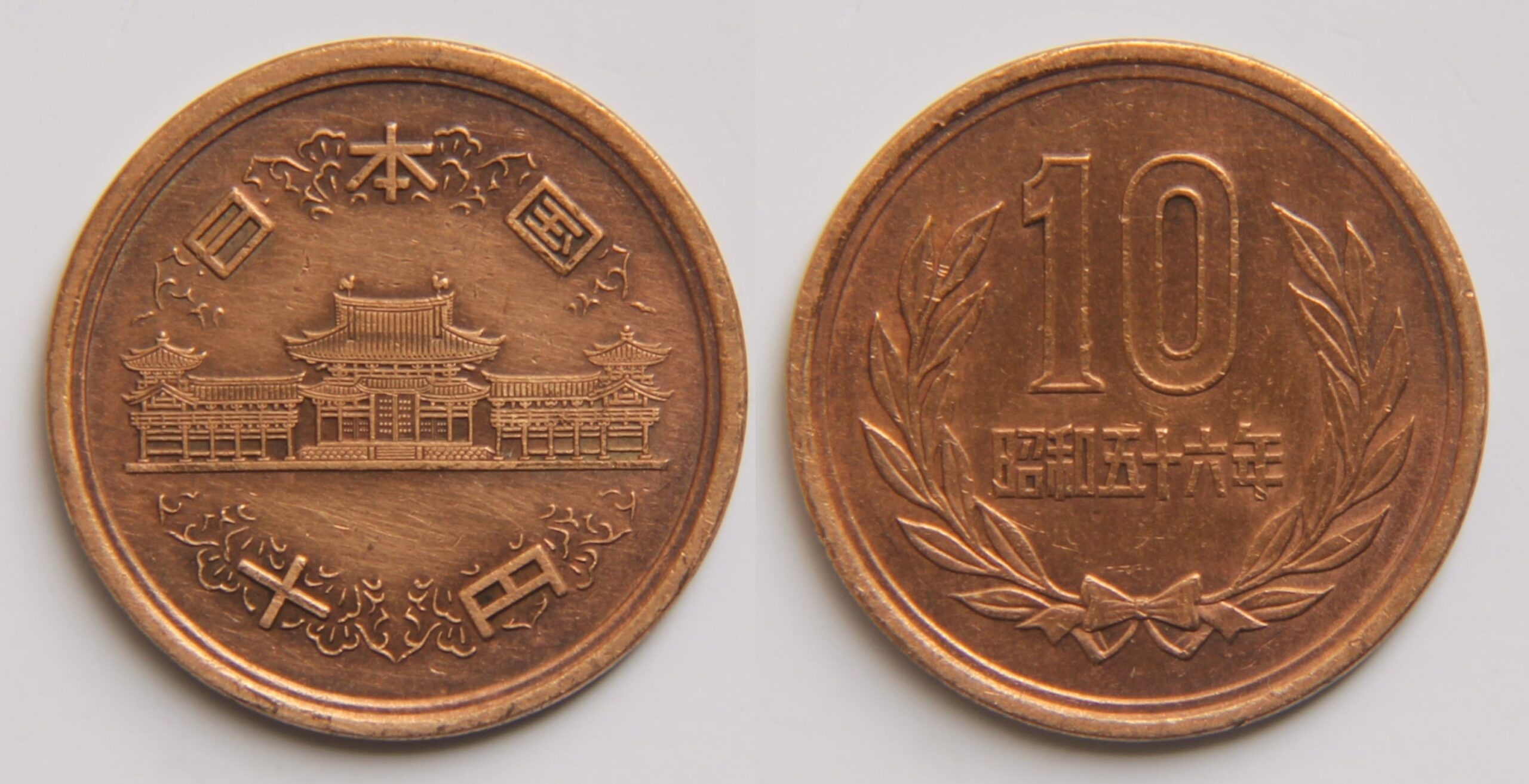
Specifications
- Denomination
- 10 yen
- Series
- Japanese yen — circulating coinage
- Years of issue
- 1951–present
- Weight
- 4.5 g
- Diameter
- 23.5 mm
- Key mintages
- Japan Mint annual production (calendar year, rounded, commemoratives excluded). Reeded (Y#73) keys: 1958: 25,000,000; 1957: 50,000,000. Plain edge (Y#73a) begins 1959: 62,400,000; later Showa lows per CoinsBook: 1986: 68,960,000; 1989 (Showa 64): 74,692,000.
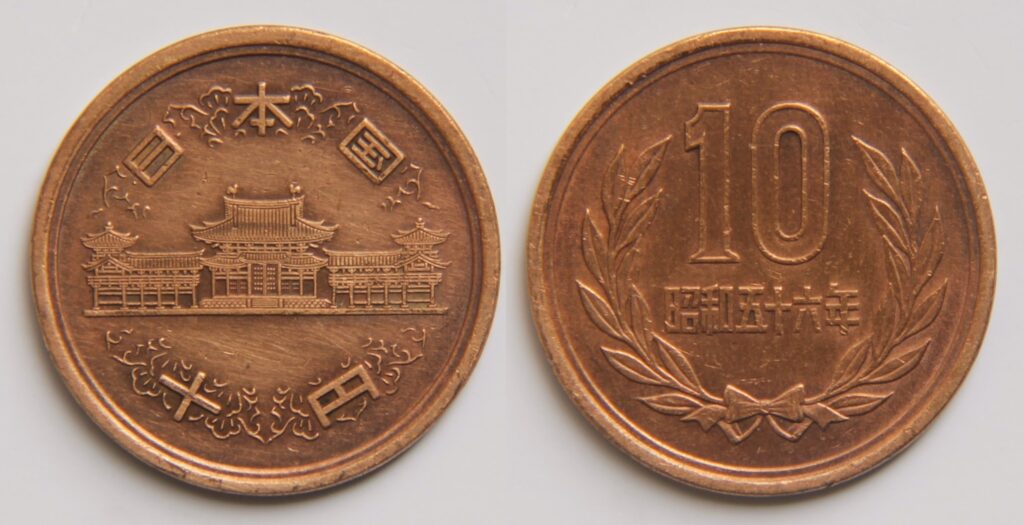
Japan’s 10 yen bronze coin has shown the Phoenix Hall of Byodo-in since 1951 (Showa 26): 4.5 g, 23.5 mm, reeded from 1951–1958 and plain-edged from 1959 — the edge is the collector’s instant date diagnostic.
History
- The bronze 10 yen was first issued in 1951 (Showa 26) with a reeded edge; the plain-edge type appeared in 1959 (Showa 34) and continues today — both types remain legal tender. (Japan Mint; Ministry of Finance)
- Obverse: the Phoenix Hall of Byodo-in in Uji, Kyoto — inscribed on the UNESCO World Heritage list in 1994 as part of the Historic Monuments of Ancient Kyoto; reverse: evergreen leaves around the “10” and nengo date. (Japan Mint)
- Bronze of copper 95%, zinc 3–4%, tin 1–2% (copper exact; zinc/tin official ranges — the Japan Mint publishes no exact figures); 4.5 g, 23.5 mm, medal alignment. (Japan Mint)
- Reeded-type mintages fell sharply at the end of the run: 1957 (50,000,000) and 1958 (25,000,000) are the keys of the reeded series. (Japan Mint)
- Plain-edge production began in 1959 at 62,400,000; later low Showa years include 1986 (68,960,000) and 1989/Showa 64 (74,692,000). (Japan Mint; CoinsBook)
- Catalog mapping: Y#73 (reeded), Y#73a (Showa plain), Y#97.1 (Heisei 1/1989), Y#97.2 (Heisei 2–31) — the edge tells the type at a glance. (Allnumis; LastDodo)
Key dates and varieties
- Reeded (Y#73), 1951–1958 — 1951: 101,068,000; 1952: 486,632,000; 1953: 466,300,000; 1954: 520,900,000; 1955: 123,100,000; 1956: 91,300,000; 1957: 50,000,000; 1958: 25,000,000. (Japan Mint)
- Plain edge (Y#73a Showa / Y#97.1 Heisei 1 / Y#97.2 Heisei 2–31), 1959–present — first year 1959: 62,400,000; Showa lows: 1986: 68,960,000; 1989 (Showa 64): 74,692,000. (Japan Mint; CoinsBook; LastDodo)
- Edge diagnostic: reeded = 1951–1958 only; plain = 1959 onward. (Ministry of Finance; Allnumis)
- All figures: Japan Mint annual production, calendar year, rounded, commemoratives excluded.
Specifications
- Denomination: 10 yen — Years: 1951–present (Showa 26 – Reiwa 8)
- Composition: Bronze — copper 95%, zinc 3–4%, tin 1–2% (copper exact; zinc/tin official ranges — no exact figures published). (Japan Mint)
- Weight: 4.5 g — Diameter: 23.5 mm — Thickness: 1.5 mm. (Japan Mint; Allnumis)
- Edge: Reeded (1951–1958); Plain (1959–present). (Ministry of Finance; Allnumis)
- Mint marks: None — no mint marks used; all production at the Japan Mint, Osaka. (Allnumis)
- Catalog: Y#73 (reeded, 1951–1958); Y#73a (Showa plain, 1959–1989); Y#97.1 (Heisei 1, 1989); Y#97.2 (Heisei 2–31, 1990–2019). (Allnumis; LastDodo)
Collector notes
- Check the edge first: reeded = 1951–1958 (Y#73, scarcer); plain = 1959–present (Y#73a/Y#97.x). (Ministry of Finance; Allnumis)
- The date sits on the reverse under the large “10” as a nengo date (e.g. 昭和四十九年 = Showa 49 = 1974). (CoinsBook)
- Reeded keys: 1958 (25,000,000) and 1957 (50,000,000) — the two lowest mintages of the bronze type’s first run. (Japan Mint)
- The obverse is the Phoenix Hall of Byodo-in, Uji, Kyoto — inscribed on the UNESCO World Heritage list in 1994 as part of the Historic Monuments of Ancient Kyoto. (Japan Mint)
- Bronze tones to chocolate brown with age — that’s normal and desirable; never polish it off. (composition per Japan Mint)
Market check
Recent eBay sales

Confirmed realized sales only — our monitor records a sale when a live eBay listing’s available quantity drops. Never asking prices.
Compare live listings for this coin on eBay:
Search eBay for Japan 10 Yen Bronze
As an eBay Partner, The Coin Wiki may earn from qualifying purchases.
FREE DOWNLOAD
Before you spend that coin, check it.
The Pocket Change Key-Date Checklist covers the cents, nickels, dimes, quarters and halves still hiding in circulation — including the 1943 and 1983 errors worth five figures. One page to print, a lifetime of jars to check.