
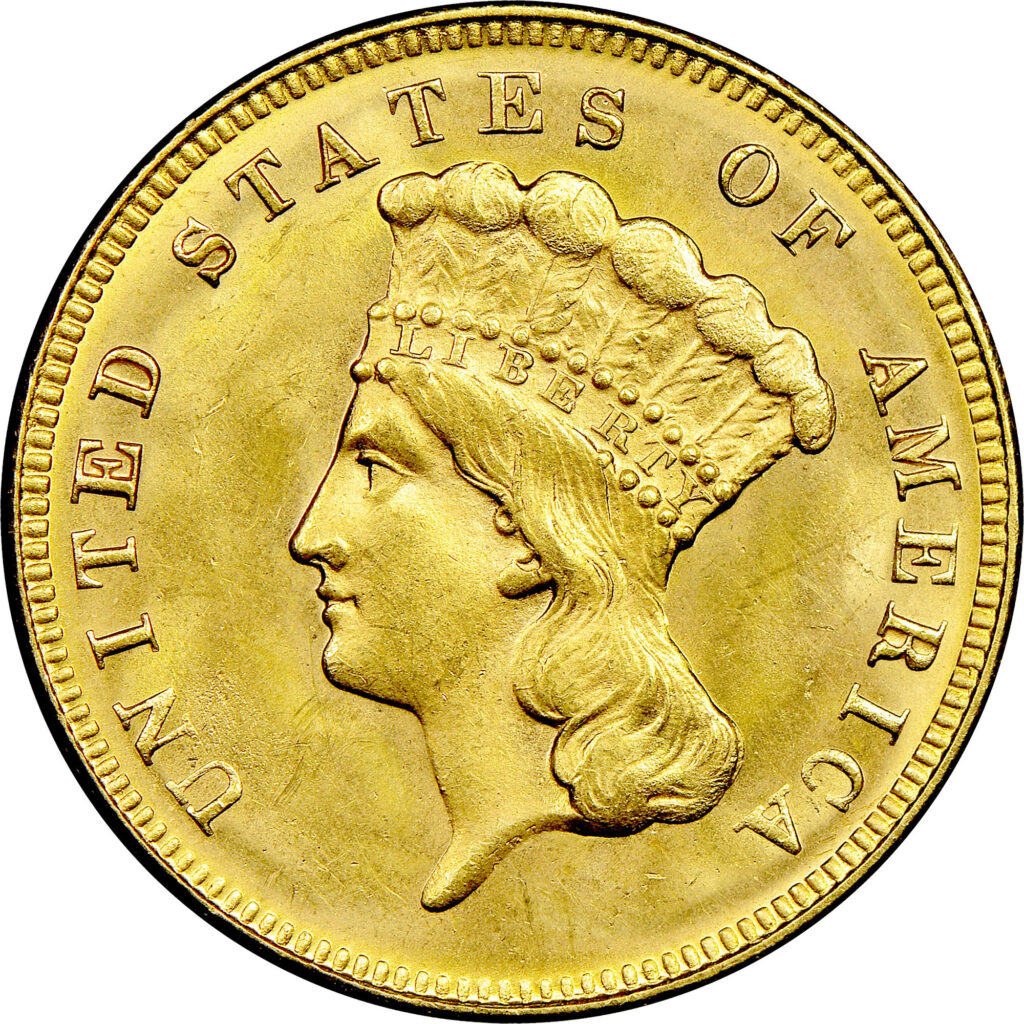
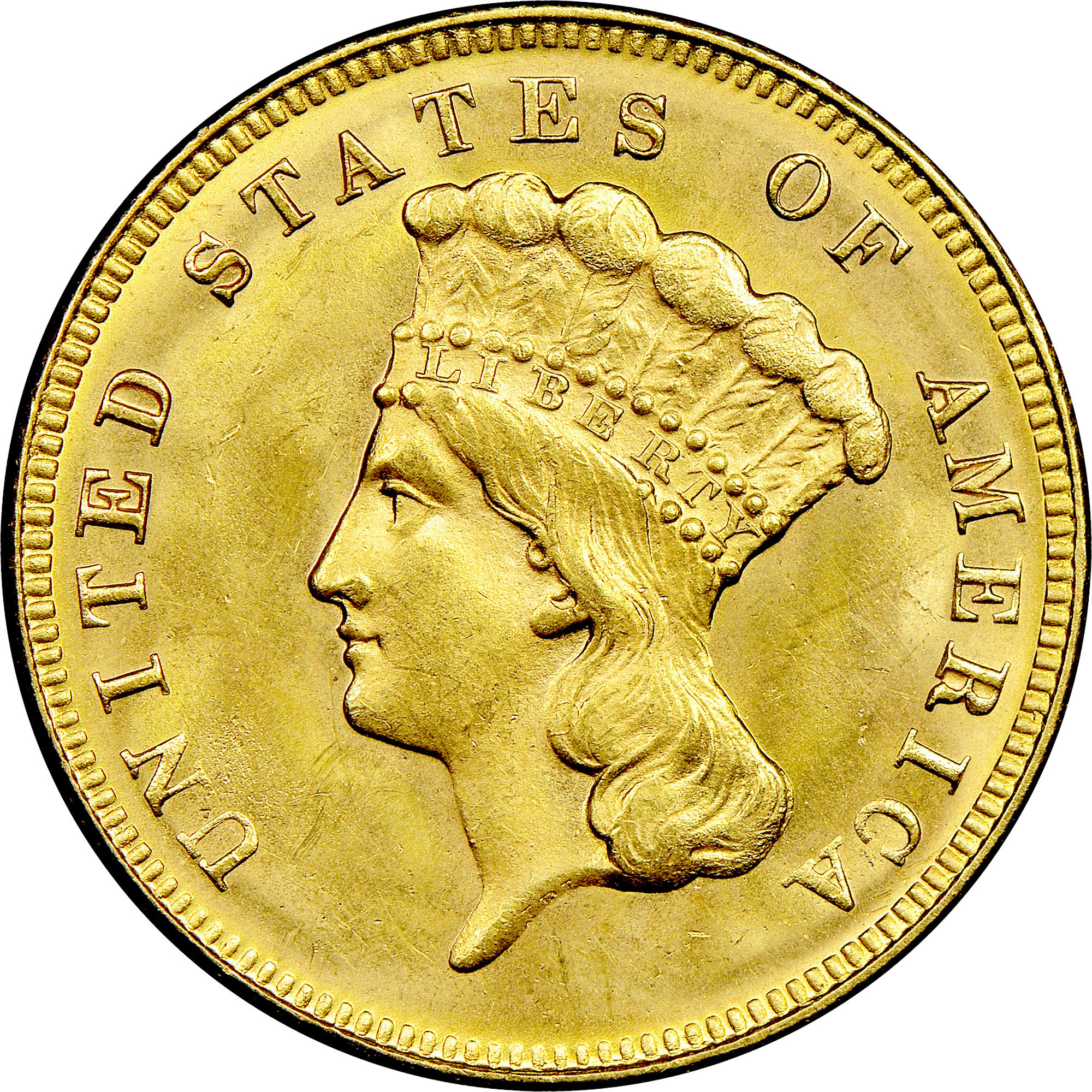
The three-dollar gold piece (1854–1889) is America’s oddest gold denomination — struck for 36 years yet barely used. Common dates trade near $1,000 in XF, while keys like the 1854-D ($114,000+), the proof-only 1875 and 1876 (six figures), and the unique 1870-S ($5.52 million) are trophies.
History
Authorized by the Act of February 21, 1853, the three-dollar gold piece was designed by Mint Chief Engraver James B. Longacre. The obverse shows Liberty as a Native American princess in a feathered headdress; the reverse bears Longacre’s “agricultural wreath” of corn, wheat, cotton, and tobacco. Longacre struck the coin on a thin, wide planchet specifically to distinguish it from the similarly sized quarter eagle ($2.50).
Why a $3 coin? By some accounts, it was meant to buy a full sheet of 100 three-cent stamps in one transaction (the first-class rate was 3¢). Walter Breen favored the postal explanation; Walter Hagans argued the real reason was California’s abundant gold (per Wikipedia).
Over 100,000 were struck in the first year (138,618 at Philadelphia, plus 24,000 at New Orleans and 1,120 at Dahlonega in 1854), but the coin saw little use. It circulated somewhat on the West Coast, lost its place in the East during the Civil War, and never regained it. The series ended in 1889; Congress abolished the denomination in 1890.
What is it worth
PCGS CoinFacts (Ron Guth) notes only a few dates can be considered common — 1854, 1874, and 1878 — and most dates have mintages below 10,000 coins. Observed values:
- Common dates (type coins): the 1874 (mintage 41,800) and 1878 (over 80,000 struck) are the most available; older catalogs put both near $1,000 in XF-40, mostly bought for type sets.
- 1854-D — the key business strike and the only $3 gold piece from Dahlonega: mintage just 1,120, perhaps ~100 known today; an MS61 sold at Heritage in 2022 for $114,000.
- 1875 — proof-only, official mintage 20: older catalog listings put Proof-65 at $175,000; precise current guides were not documented in the consulted references.
- 1876 — proof-only, official mintage 45: a PR65 CAMEO sold at Heritage in 2022 for $144,000; John W. Dannreuther estimates only 32–40 survivors (per Stack’s Bowers).
- 1870-S — unique, one example known with certainty: sold at Heritage for $5,520,000 in 2023. See our dedicated page: 1870-S Three-Dollar Gold Piece.
Grading-service populations tell the rarity story: PCGS reports only 120 examples of the 1854-D total, with just three reaching MS-60 (none above MS-62).
What drives the premium
- Date rarity: the low-mintage branch issues (1854-D) and proof-only dates (1875, 1876) are the series keys; common Philadelphia dates of the 1870s–1880s are the type-coin dates.
- Grade: most dates are genuinely rare above MS-62; Gem examples bring multiples of XF prices.
- Originality: many $3 gold pieces were made into love tokens in the 1880s (one side shaved for engraving) or turned into jewelry — damaged pieces trade at steep discounts.
- Varieties: the 1873 Open 3 vs. Closed 3 distinction matters — the Open 3 is proof-only and rarely seen at auction.
How to identify the valuable variety
- 1873 Open 3 vs. Closed 3: on January 18, 1873, Chief Coiner A. L. Snowden complained the “3” in the date too closely resembled an “8”; Chief Engraver William Barber re-engraved the date with wider-open arms. The Open 3 (proof-only, ~25 struck) shows a “3” with wide, open upper and lower arms; the Closed 3 (official mintage 25) has tighter, nearly closed arms.
- 1854 small vs. large “Dollars”: 1854 reverses read “Dollars” in small letters; from 1855 onward the letters were enlarged.
- Mint marks (D, O, S) sit immediately below the wreath on the reverse; Philadelphia pieces have no mint mark.
- Counterfeits are common: the high value of keys makes this series a favorite of forgers. Buy PCGS/NGC-certified examples, verify weight (5.015 g) and diameter (20.5 mm), and be suspicious of any raw 1875, 1876, or 1854-D offered at “too good to be true” prices.
Specifications
- Years: 1854–1889
- Composition: 90% gold, 10% copper
- Weight: 5.015 g (0.1451 troy oz gold)
- Diameter: 20.5 mm (0.807 in)
- Edge: reeded
- Designer: James B. Longacre
- Obverse: Liberty as a Native American princess in feathered headdress
- Reverse: agricultural wreath of corn, wheat, cotton, and tobacco; small “Dollars” (1854) / large “Dollars” (1855–1889)
- Mints: Philadelphia (no mark), New Orleans (O, 1854 only), Dahlonega (D, 1854 only), San Francisco (S, 1855–1857, 1860, 1870)
Collector notes
- The $3 gold piece is a one-coin type set classic — most collectors buy a single 1874 or 1878 in AU and call the series complete.
- Watch for ex-jewelry damage: solder marks and polished surfaces are common; problem-free original coins command strong premiums.
- The 1870-S is covered on our dedicated page (1870-S Three-Dollar Gold Piece) — this guide does not duplicate it.
Market check
Compare live listings for this coin on eBay:
Search eBay for Three-Dollar Gold Piece (1854–1889) Series Guide
As an eBay Partner, The Coin Wiki may earn from qualifying purchases.
FREE DOWNLOAD
Before you spend that coin, check it.
The Pocket Change Key-Date Checklist covers the cents, nickels, dimes, quarters and halves still hiding in circulation — including the 1943 and 1983 errors worth five figures. One page to print, a lifetime of jars to check.