
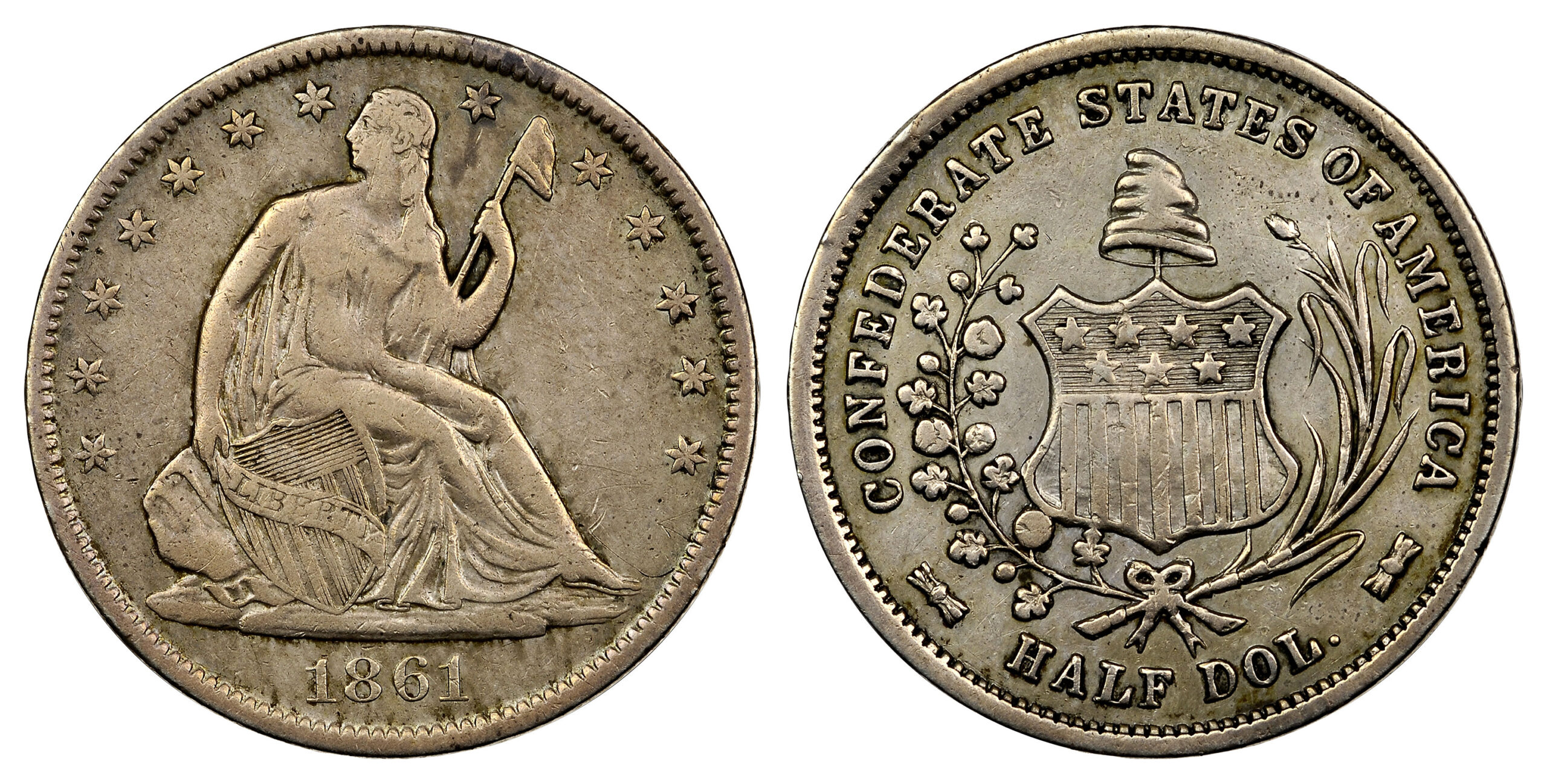
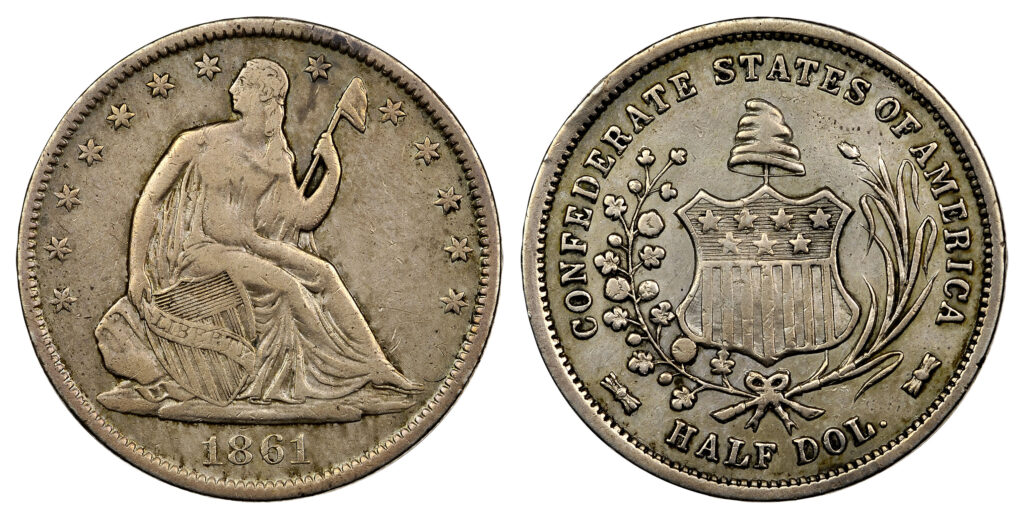
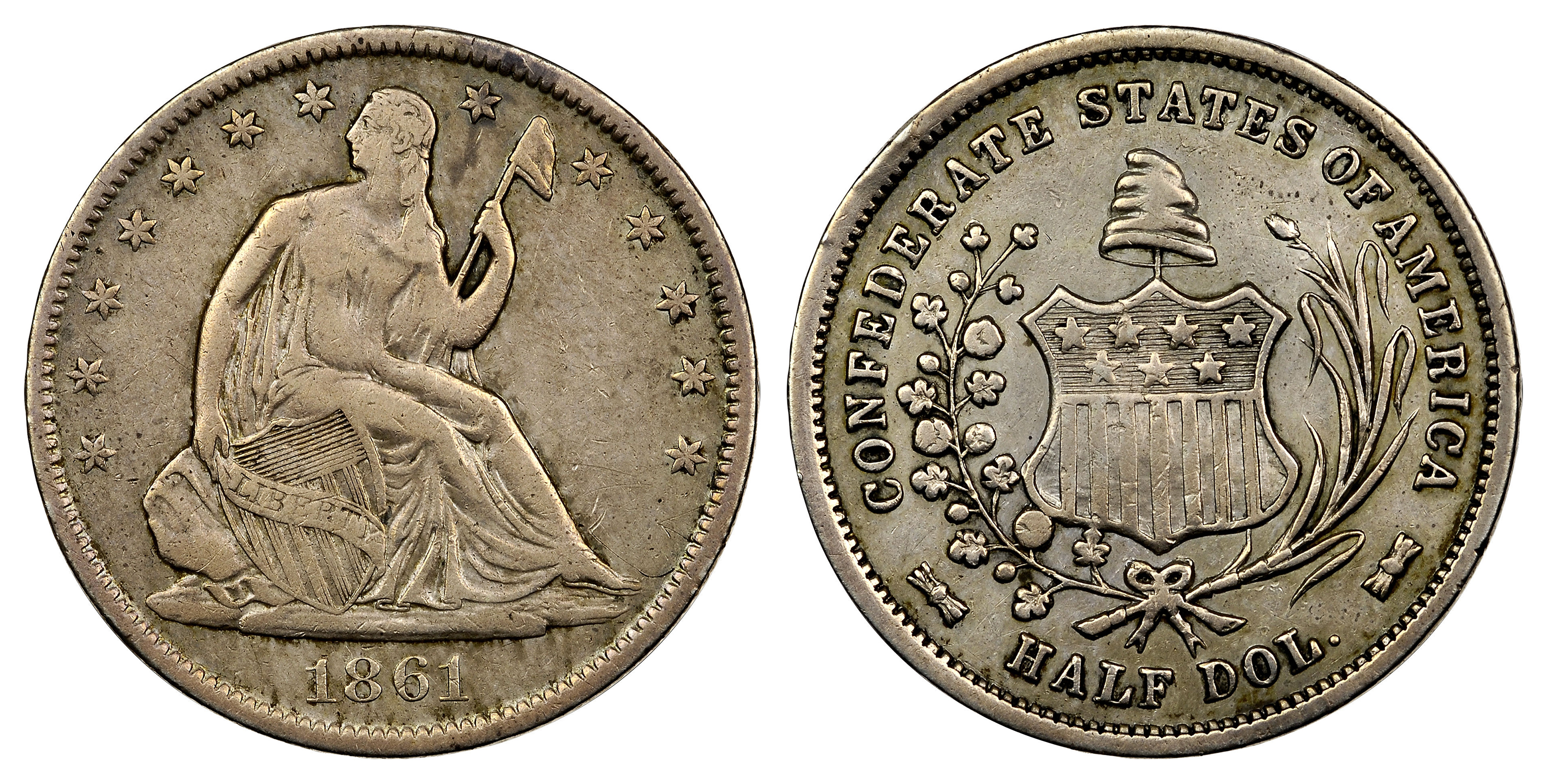
Only four original 1861 Confederate half dollars were ever struck — but hundreds of thousands of restrikes and cheap replicas exist. Here’s how to tell which category any given coin belongs to, and what each is worth.
History
When the New Orleans Mint fell to the Confederacy in early 1861, it kept striking half dollars with existing U.S. dies — a total of 2,532,633 half dollars dated 1861-O were produced under three different authorities: about 330,000 under the U.S., 1,240,000 under the State of Louisiana, and 962,633 under the Confederate States of America. But the Confederacy wanted its own coinage. In April 1861, using the regular Seated Liberty obverse die and a new reverse reading CONFEDERATE STATES OF AMERICA / HALF DOL., exactly four half dollars were struck. They were presented to President Jefferson Davis, Professor J. L. Riddell of the University of Louisiana, Dr. E. Ames of New Orleans, and the fourth was kept by the chief coiner of the New Orleans Mint, Dr. B. F. Taylor. A lack of bullion kept the coin from ever entering real production.
The story didn’t end there. In 1879, the Philadelphia dealer Ebenezer Mason Jr. purchased the original Confederate reverse die from Dr. Taylor, then sold it to J. W. Scott & Co. of New York. Scott bought 500 ordinary 1861-O half dollars, planed off their reverses, and restruck the Confederate design onto them — the famous “Scott restrikes,” sold to collectors for $2 each.
What is it worth
The four originals are numismatic treasures: one sold at Stack’s in 2003 for $632,000, and another — graded NGC PR-40 — sold at Heritage in November 2017 for $960,000. An original was insured for $1 million at the 2018 ANA World’s Fair of Money. Scott restrikes, struck with the original die in 1879, are genuine 19th-century pieces worth far less but still serious money: a 2019 Red Book lists them at $15,000 in Uncirculated, with high-grade certified examples often selling for several thousand more; a reference guide figure for a certified gem example sits around $8,600. Even more affordable are the Robert Bashlow “restrikes” — tokens struck from his own dies in 30,000 pieces — which can still cost over $1,000 in certified condition. And the ordinary 1861-O half dollar on which it all rests is available at modest prices (around $30 in Good-4, $450 in MS-60), though examples with a die crack running from Liberty’s nose to the rim — a characteristic of the die used during the Confederate period — can command roughly double.
What drives the premium
Everything rides on pedigree: one of four originals versus a Scott restrike versus a later token versus a cheap modern replica. Among the four originals, provenance matters enormously — the Taylor piece now resides at the American Numismatic Society, and the Ames piece passed through collectors including Eric P. Newman before its $960,000 sale. For Scott restrikes, the flattened, mirror-like surfaces from the reverse-removal process and the quality of the strike drive grade and price.
How to identify genuine examples
Assume nothing. The market is flooded with replicas, tokens, and copies, and calling them “restrikes” is often fallacious — Bashlow’s pieces were struck from his own dies, not the originals. Rules of thumb: only buy an original or Scott restrike certified by a major grading service; originals are essentially proof strikes (one graded PCGS Gold Shield SP40 CAC), while Scott restrikes show a flattened obverse from the planing of the host coin and can be attributed to the New Orleans-struck W-13 “Bisected Date” obverse die. The Scott tokens sold alongside them carry the inscription “4 ORIGINALS STRUCK BY ORDER OF C.S.A. IN NEW ORLEANS 1861” on the reverse. Anything raw, cheap, and offered without provenance should be treated as a replica until proven otherwise.
Specifications
Date and mint: 1861, New Orleans. Composition: silver (originals struck as presentation pieces; Scott restrikes struck on planed 1861-O Seated Liberty hosts). Denomination: half dollar. Designer of Confederate reverse: engraver from the original New Orleans Mint staff. Diameter and weight of individual examples were not verified in the consulted references.
Collector notes
The Confederate cent is a related “what if”: about a dozen original Lovett cents exist, struck in Philadelphia under mysterious circumstances, with restrikes made later by John Haseltine. For most collectors, a certified Scott restrike is the realistic way to own a piece from the original Confederate die. If you want the Civil War story without the five-figure price, the 1861-O Seated Liberty half dollar — the last half dollar produced at New Orleans — is a genuinely historic and affordable alternative.
Market check
Compare live listings for this coin on eBay:
Search eBay for 1861 Confederate Half Dollar
As an eBay Partner, The Coin Wiki may earn from qualifying purchases.
FREE DOWNLOAD
Before you spend that coin, check it.
The Pocket Change Key-Date Checklist covers the cents, nickels, dimes, quarters and halves still hiding in circulation — including the 1943 and 1983 errors worth five figures. One page to print, a lifetime of jars to check.