
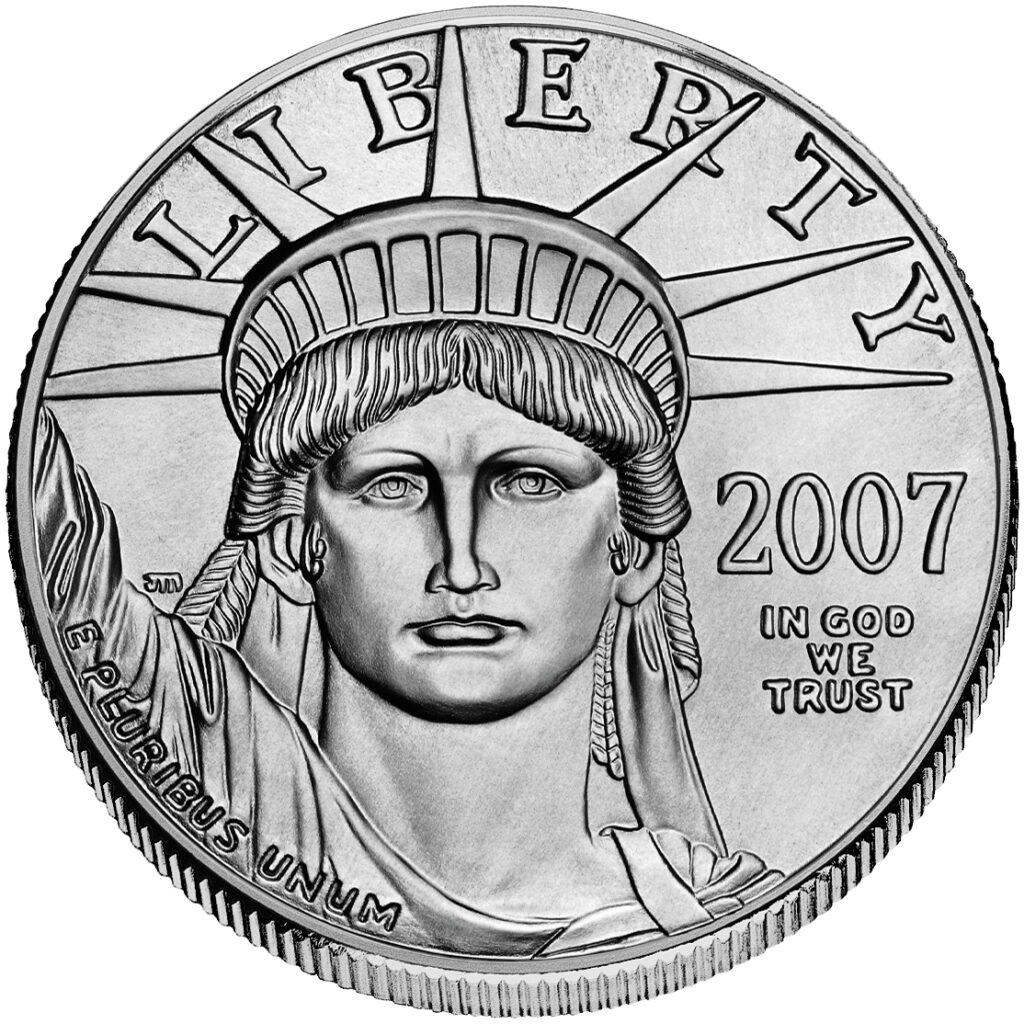
Specifications
- Denomination
- $100 (1 oz); $50 (1/2 oz); $25 (1/4 oz); $10 (1/10 oz)
- Series
- American Eagle
- Designer
- Obverse: John Mercanti (Statue of Liberty); Reverse: Thomas D. Rogers (eagle at sunrise)
- Edge
- Reeded
- Key mintages
- 1997 first-year figures verified via dealer/mint-table sources; burnished-year table not fully verified – not asserted
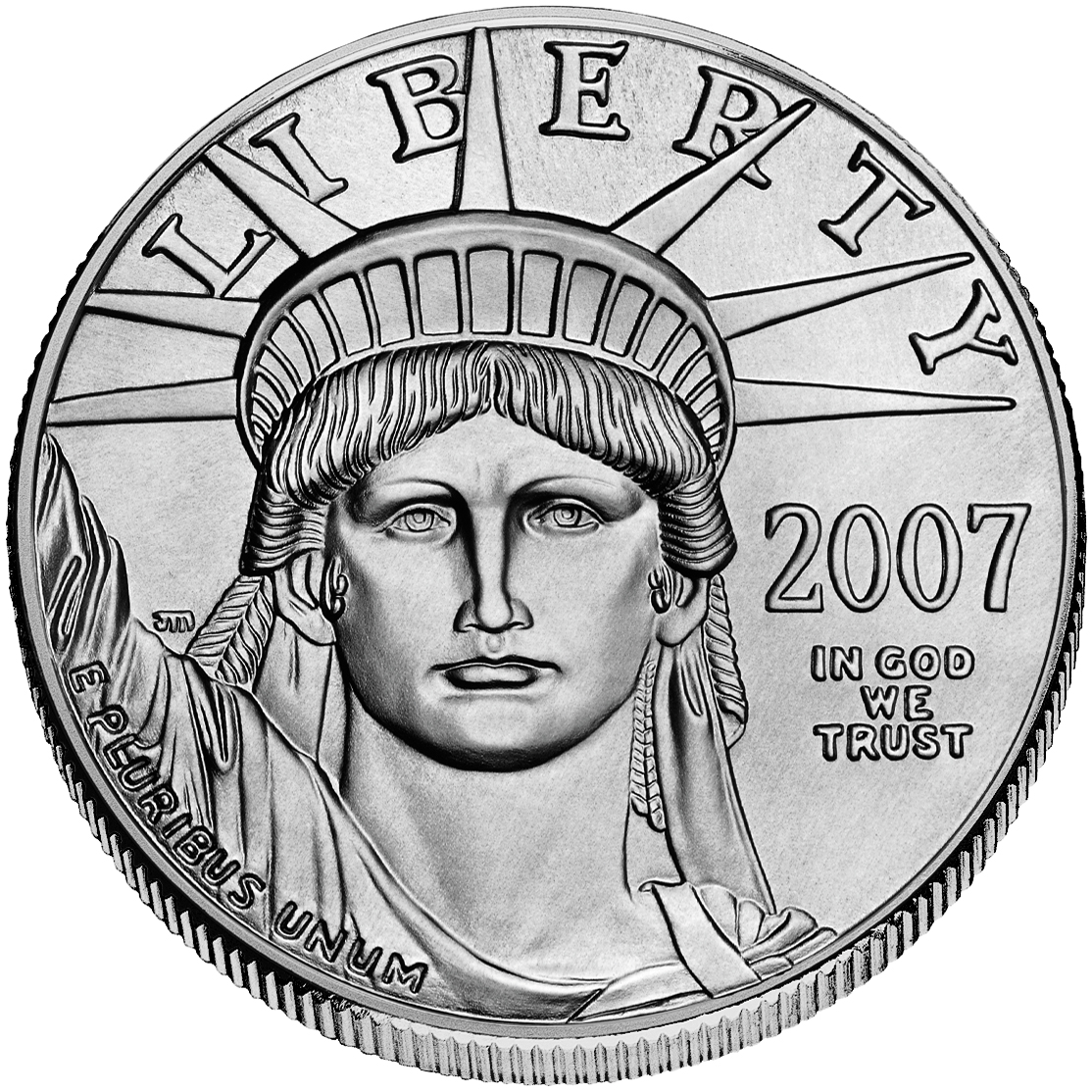
The Mint's only platinum Eagle: a full ounce of .9995 platinum since 1997, with a $100 face value — the highest denomination ever placed on a U.S. coin.
History
- Congress authorized .9995 platinum coinage in 1996, and the U.S. Mint launched the American Platinum Eagle in 1997 — the fourth and final series in the American Eagle bullion family, after the Gold, Silver, and (later) Palladium Eagles (U.S. Gold Bureau; JM Bullion).
- The Platinum Eagle is the only Eagle series to use modern artwork rather than historic designs: John Mercanti's close-up portrait of the Statue of Liberty on the obverse and Thomas D. Rogers's eagle soaring at sunrise on the reverse (APMEX; JM Bullion; L&C Coins).
- From 1997 through 2008 the Mint issued four sizes — 1 oz ($100), 1/2 oz ($50), 1/4 oz ($25), and 1/10 oz ($10) — in both bullion and proof versions. The $100 face value on the one-ounce coin is the highest ever to appear on a U.S. coin (Wikipedia; U.S. Gold Bureau).
What is it worth
- A one-ounce Platinum Eagle holds 1 troy oz of .9995 platinum, so its floor is the platinum spot price times one ounce — the same melt math as any bullion coin (JM Bullion).
- Scarcity adds a real premium: the 1997 first-year 1 oz bullion issue had a declared mintage of just 56,000 coins, and the 1997-W 1 oz proof mintage was 20,851 — tiny next to Gold Eagle mintages (JM Bullion; L&C Coins).
- Proofs and the later burnished "W" uncirculated collector versions trade at collector premiums well above melt; bullion versions track platinum spot plus a modest dealer premium (Wikipedia; JM Bullion).
What drives the premium
- Platinum itself: an industrial precious metal with a smaller, more volatile market than gold, so Platinum Eagle prices swing harder with spot (JM Bullion).
- Low mintages across the series — the entire bullion run ended in 2008, and most dates saw far fewer coins struck than their gold and silver counterparts (U.S. Gold Bureau).
- Collector demand for the proof and "W" burnished versions, which were sold directly by the Mint in presentation packaging (Wikipedia; JM Bullion).
How to identify the valuable variety
- Bullion Platinum Eagles carry no mintmark; the collector versions are distinguished by the West Point "W" mintmark — proofs carry it, and the later burnished uncirculated issues were struck on burnished blanks with the "W" to separate them from bullion strikes (Wikipedia).
- Proofs show mirror fields and frosted devices and came in Mint packaging with a certificate; burnished "W" coins have a satin-like finish distinct from both bullion and proof (Wikipedia; JM Bullion).
- Fractionals (1/2, 1/4, 1/10 oz) are marked with their weight and fineness (.9995 PLATINUM) on the reverse alongside their face values — verify weight and diameter against the series specs before buying (Wikipedia; APMEX).
Specifications
- Composition: .9995 fine platinum (Wikipedia; JM Bullion)
- Weight (1 oz): 31.12 g (1.0005 troy oz) (Wikipedia)
- Diameter (1 oz): 32.7 mm (Wikipedia; L&C Coins)
- Edge: Reeded (L&C Coins; JM Bullion)
- Face values: $100 (1 oz), $50 (1/2 oz), $25 (1/4 oz), $10 (1/10 oz) (Wikipedia)
- Designers: Obverse: John Mercanti (Statue of Liberty); reverse: Thomas D. Rogers (eagle at sunrise) (APMEX; L&C Coins)
- Mint marks: None on bullion; "W" (West Point) on proofs and burnished collector versions (Wikipedia)
Collector notes
- Platinum Eagles are eligible for precious-metals IRAs, which keeps steady institutional-style demand behind the series (APMEX).
- Because the series is far less collected than Gold and Silver Eagles, certified high-grade proofs can offer genuine scarcity at modest multiples of melt — but liquidity is thinner, so buy the coin, not the story (JM Bullion).
Market check
Compare live listings for this coin on eBay:
Search eBay for American Platinum Eagle
As an eBay Partner, The Coin Wiki may earn from qualifying purchases.
FREE DOWNLOAD
Before you spend that coin, check it.
The Pocket Change Key-Date Checklist covers the cents, nickels, dimes, quarters and halves still hiding in circulation — including the 1943 and 1983 errors worth five figures. One page to print, a lifetime of jars to check.