
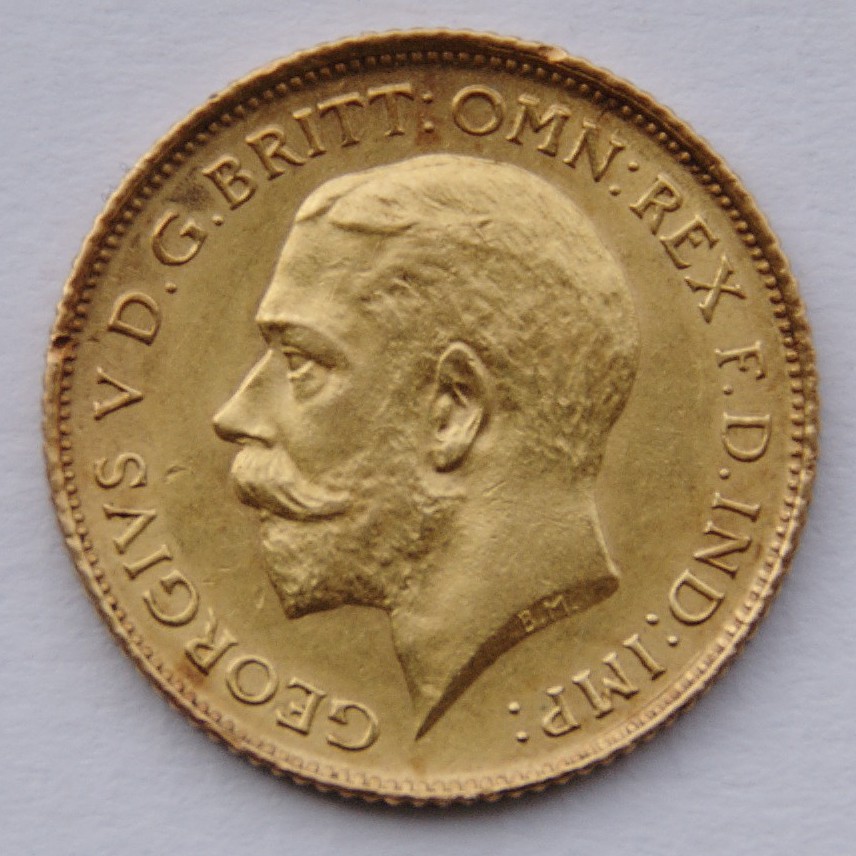
Specifications
- Denomination
- Half sovereign (10 shillings)
- Series
- British Gold Sovereigns
- Designer
- Benedetto Pistrucci (St. George reverse; obverse portrait varies by monarch)
- Years of issue
- 1817–present
- Composition
- 91.67% Gold, 8.33% Copper
- Weight
- 3.994 g
- Diameter
- 19.3 mm
- Key mintages
- No total mintage verified across the full 1817–present run; per-date mintages vary.
Melt value: $416.00
Britain's small gold workhorse: 3.994 g of 22-carat gold holding 0.1177 oz of pure gold — colonial mint marks and early dates carry the premiums.
History
- The half sovereign was reintroduced in its modern form in 1817 as part of Britain's Great Recoinage, was struck in most years until 1926, then was suspended except for coronation-year issues until the Royal Mint resumed production in 1980 as a collector and bullion piece (Wikipedia).
- Benedetto Pistrucci's St George and the Dragon reverse — first used on the sovereign in 1817 — appeared on the half sovereign from 1893; earlier issues used the crowned shield reverse (Wikipedia).
- Half sovereigns were also struck at colonial branch mints in Australia (Sydney, Melbourne, Perth), South Africa (Pretoria), India (Bombay), and Canada (Ottawa), with the mint marks S, M, P, SA, I, and C on the reverse (Wikipedia).
What is it worth
- Melt value = 0.1177 × the current gold spot price per troy ounce (Chards). Common-date circulated pieces trade at a modest premium over melt as bullion (Atkinsons).
- Numismatic premiums concentrate in early dates, colonial branch-mint issues, and high-grade or proof examples (Chards).
What drives the premium
- Value drivers: 0.1177 troy oz of pure gold sets the floor; the mint mark (colonial branch mints over London), the reverse type (shield back vs. St George), date rarity, and condition set the premium (Wikipedia; Chards).
How to identify the valuable variety
- Check the reverse: pre-1893 issues carry the crowned shield; from 1893 the St George and the Dragon design (Wikipedia).
- Look for the mint mark in the reverse exergue — S, M, P, I, SA, or C identifies a colonial branch-mint strike, which collectors prize over common London dates (Wikipedia).
- Modern bullion half sovereigns (1980–present) carry no mint mark and trade near melt unless proof (Wikipedia; Chards).
Specifications
- Composition: 22-carat gold, 91.67% Au (Wikipedia; Chards)
- Weight: 3.994 g (Wikipedia)
- Gold content: 0.1177 troy oz AGW — 3.994 g × 0.9166 (Chards); melt value = 0.1177 × the current gold spot price
- Diameter: 19.30 mm (Chards; Atkinsons)
- Edge: Milled (Wikipedia)
- Designers: Reverse: Benedetto Pistrucci — St George and the Dragon (from 1893); obverse portrait of the reigning monarch varies (Wikipedia)
- Mints: London (no mint mark); Sydney (S), Melbourne (M), Perth (P), Bombay (I), Pretoria (SA), Ottawa (C) (Wikipedia)
- Years: 1817–1926 for circulation; 1980–present as bullion/collector (Wikipedia)
Collector notes
- Quick authenticity screen: a genuine half sovereign weighs 3.99 g and measures 19.30 mm (Chards; Atkinsons).
- See also the World Gold Coins hub for more classic gold issues.
Market check
Compare live listings for this coin on eBay:
Search eBay for British Gold Half Sovereign
As an eBay Partner, The Coin Wiki may earn from qualifying purchases.
FREE DOWNLOAD
Before you spend that coin, check it.
The Pocket Change Key-Date Checklist covers the cents, nickels, dimes, quarters and halves still hiding in circulation — including the 1943 and 1983 errors worth five figures. One page to print, a lifetime of jars to check.