
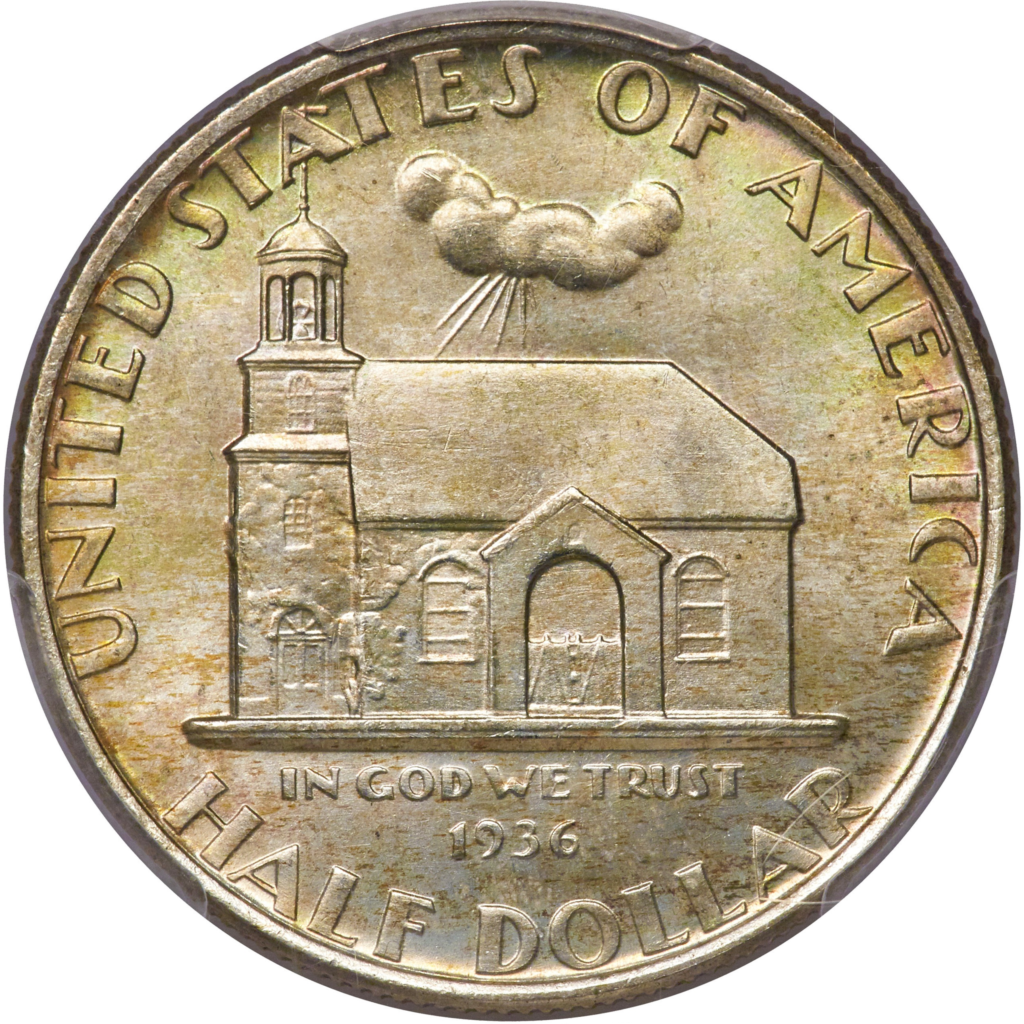
Specifications
- Denomination
- Half dollar
- Designer
- Obverse: Old Swedes Church — Carl L. Schmitz; reverse: the ship Kalmar Nyckel — Carl L. Schmitz
- Weight
- 12.5 g
- Diameter
- 30.61 mm
- Edge
- Reeded

Dated 1936, struck in 1937, celebrating 1638–1938 — the Delaware Tercentenary half dollar is the three-date commemorative, and a PCGS MS68 set the issue’s auction record at $19,200 in August 2025 (CoinWeek).
History
- The Delaware Tercentenary half dollar (also called the Swedish Delaware half dollar) marked the 300th anniversary of the first successful European settlement in Delaware — the 1638 landing of the Swedish ships Kalmar Nyckel and Fogel Grip under Peter Minuit, which founded New Sweden near present-day Wilmington (Wikipedia).
- Legislation came during the 1936 peak of commemorative-coin abuses, when Congress began adding collector protections. A joint resolution introduced by Pennsylvania’s Joseph F. Guffey on March 4, 1936, was rewritten in subcommittee by Colorado’s Alva B. Adams: the coins could be struck at only one mint, with at least 25,000 struck at a time, and all had to be dated 1936. It became law with President Franklin D. Roosevelt’s signature on May 15, 1936, despite a drafted Treasury veto message over fears of public confusion and counterfeiters (Wikipedia; CoinWeek).
- The Delaware Swedish Tercentenary Commission ran an open design competition — 38 entries (Congressional records from 1938 say 40 designs) vying for a $500 prize, judged by Mint Chief Engraver John R. Sinnock and sculptor R. Tait McKenzie. Carl L. Schmitz, an American of German and French descent, won; the Medallic Art Company of New York reduced his models to coin-sized hubs (Wikipedia; CoinWeek).
- The Philadelphia Mint struck 25,015 coins in March 1937, including 15 for the following year’s Assay Commission. The commission sold them through Wilmington’s Equitable Trust Company at $1.75 each; 20,978 sold and 4,022 unsold pieces were returned for melting. Proceeds funded the 1938 tercentenary celebrations, held in both Sweden and the United States (Wikipedia; CoinWeek). This entry is part of the Classic U.S. Commemoratives series.
What is it worth
- The headline sale: in August 2025 Heritage Auctions sold a PCGS MS68 from the Gregg Bingham Collection for $19,200 — the auction record PCGS reports for the issue. For years the benchmark had been a PCGS MS67 with CAC approval sold by Heritage in January 2012 for $18,400 (CoinWeek).
- Ordinary collector grades are far lower: CoinWeek notes that in 2020, MS64 and MS65 examples could often be found for less than $300 while MS67 examples commonly traded near $700 — period figures that describe that market, not fixed present-day values (CoinWeek).
- Supply supports both tiers: PCGS estimates about 17,000 survive in all grades, roughly 13,500 at MS60 or better, and about 6,500 at MS65 or better — most survivors are Mint State because collectors, not spenders, bought them at $1.75 (CoinWeek; GreatCollections).
What drives the premium
- Extreme-top registry competition: at MS67/MS68 the market changes sharply, as the $19,200 record against sub-$300 MS64/65 levels shows (CoinWeek).
- Surface quality: the broad church roof and the Kalmar Nyckel’s sails attract and show contact marks, so clean, well-struck coins with strong original luster are what buyers pursue; blotchy toning reduces eye appeal (CoinWeek).
- Net mintage clarity: 25,015 struck minus 4,022 melted leaves 20,978 sold, but PCGS and standard references list net mintage as 20,993 — adding the 15 assay pieces (CoinWeek).
- The three-date story: 1936 on the obverse by law, struck in 1937, anniversary dates 1638–1938 on the reverse — a chronology that draws collector interest few issues can match (CoinWeek).
Specifications
- Composition: 90.0% silver, 10.0% copper (Wikipedia)
- Weight: 12.5 g (Wikipedia)
- Silver content: 0.36169 troy oz (Wikipedia)
- Diameter: 30.61 mm (Wikipedia)
- Thickness: 2.15 mm (Wikipedia)
- Edge: Reeded (Wikipedia)
- Alignment: Not verified in consulted references
- Designers: Obverse: Old Swedes Church — Carl L. Schmitz; reverse: the ship Kalmar Nyckel — Carl L. Schmitz (Wikipedia)
- Mint: Philadelphia (no mintmark), dated 1936, struck 1937 (Wikipedia; CoinWeek)
Collector notes
- Obverse (per Mint convention) shows Old Swedes Church — Holy Trinity Church in Wilmington, consecrated in 1699, described in earlier numismatic literature as the oldest Protestant church building in the United States still used for worship (the National Park Service wording, “one of America’s oldest church buildings that still serves as a place of worship,” is the safer description). The reverse shows the Kalmar Nyckel under full sail, with the anniversary dates 1638–1938 and three diamonds referencing Delaware’s “Diamond State” nickname and its three counties: New Castle, Kent, and Sussex. The artist’s initials CLS sit right of the ship (Wikipedia; CoinWeek).
- The commission originally treated the ship side as the obverse; Mint records recognize the church side, and collectors follow the Mint today (Wikipedia).
- Sweden struck its own companion for the anniversary: a 1938 2-kronor depicting the Kalmar Nyckel, with a mintage of 508,815, designed by Erik Lindberg — readily available and often collected alongside the American half dollar (Wikipedia; CoinWeek).
- One open mystery: commemorative specialist Anthony Swiatek has suggested a small number of Matte Proof Delaware half dollars could exist, but no confirmed proof population is established — treat it as intriguing but unconfirmed (CoinWeek).
Market check
Compare live listings for this coin on eBay:
Search eBay for 1936 Delaware Tercentenary Half Dollar
As an eBay Partner, The Coin Wiki may earn from qualifying purchases.
Sources
FREE DOWNLOAD
Before you spend that coin, check it.
The Pocket Change Key-Date Checklist covers the cents, nickels, dimes, quarters and halves still hiding in circulation — including the 1943 and 1983 errors worth five figures. One page to print, a lifetime of jars to check.