
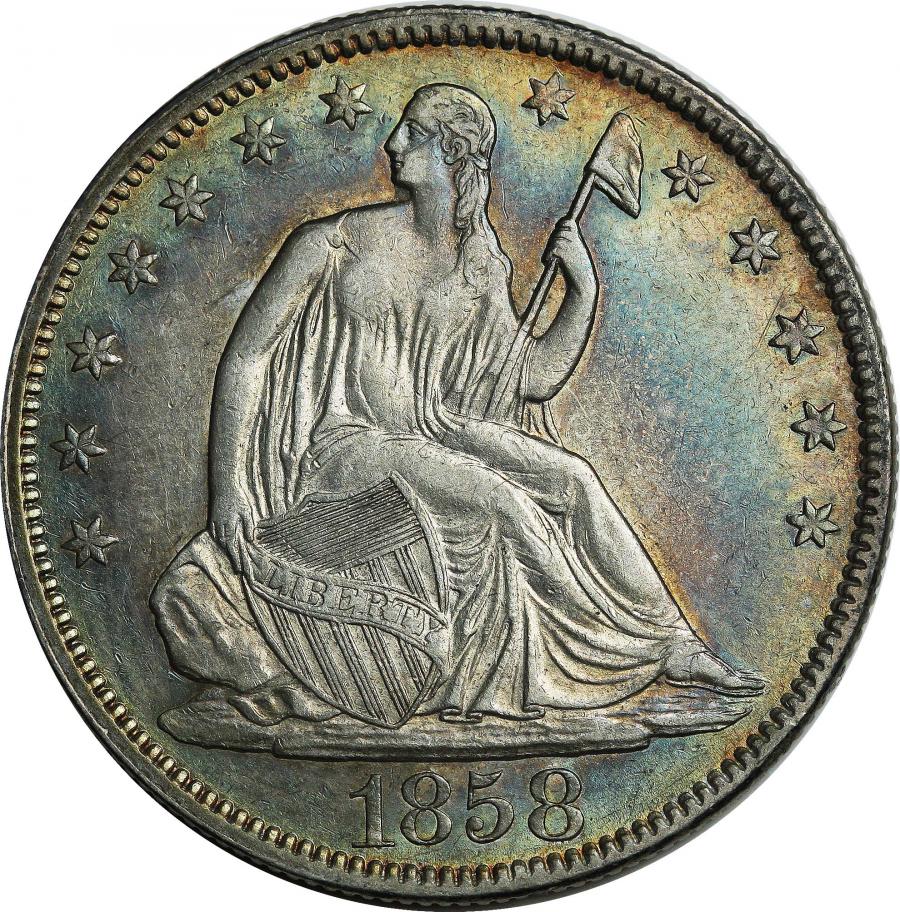
Specifications
- Denomination
- Half dollar
- Series
- Seated Liberty half dollar
- Designer
- Christian Gobrecht, after sketches by Thomas Sully
- Weight
- 12.5 g
- Diameter
- 30 mm
The Seated Liberty half dollar ran 1839–1891: Gobrecht’s design after Sully’s sketches, the Civil War motto, the 1873 weight change — and the legendary 1878-S, with a reported mintage of just 12,000 (PCGS; Numismatic News).
History
- The series began in 1839 with Christian Gobrecht’s Seated Liberty design, developed from sketches by the artist Thomas Sully, replacing the Capped Bust halves (PCGS).
- IN GOD WE TRUST was added to the reverse in 1866, creating the With Motto type that ran to the end of the series (PCGS).
- In 1873 the authorized weight rose from 192 grains to 192.9 grains (12.5 g), and arrows were placed at the date for 1873–1874 to mark the change (PCGS).
- After 1878, business-strike quantities were sharply curtailed because the Mint’s silver went into Morgan dollar production — the 1879–1890 issues are low-mintage by design (PCGS).
- Carson City joined the series in 1870, and its early-1870s issues are among the rarest Seated halves (PCGS).
What is it worth
- Older Numismatic News research (circa 2011) placed common pre-1879 dates around $32 in G-4, $360 in MS-60, and $2,700 in MS-65; PCGS’s guide lists the 1877 at $80 in G4 (Numismatic News; PCGS).
- The same research placed the low-mintage 1879–1890 issues around $260 in G-4, $700 in MS-60, and $3,650 in MS-65 — a steep premium for the Morgan-era dates (Numismatic News).
- The 1878-S, with a reported mintage of 12,000, was valued around $27,500 in G-4, $70,000 in MS-60, and $175,000 in MS-65 in that research; PCGS notes it costs mid-five figures even in lower circulated grades (Numismatic News; PCGS).
- The 1852 lists at $600 in G4 on the PCGS price guide — an early low-mintage sleeper (PCGS).
Key dates in the series
- 1878-S: reported mintage 12,000; the series’ most famous rarity, mid-five figures even in low grades (Numismatic News; PCGS).
- 1878-CC: the key Carson City half of the late series (PCGS).
- 1870-S: the first-year San Francisco issue and a major key; it has its own entry on The Coin Wiki (no figures given here).
- 1852: an early low-mintage issue, $600 in G4 on the PCGS guide (PCGS).
- 1879–1890 issues: the Morgan-era low-mintage dates, worth multiples of common dates in every grade (Numismatic News).
- 1891: the final year, mintage 200,600 (Numismatic News).
What drives the premium
- The 1878-S towers over everything: a reported 12,000 struck, and the one Seated half every advanced collector has to reckon with (Numismatic News).
- Morgan-era scarcity: after 1878 the Mint made very few business-strike halves, so the 1879–1890 dates carry built-in premiums (PCGS).
- Carson City dates of the early 1870s are rare across the board, with the 1878-CC the standout (PCGS).
- Common 1875–1877 Philadelphia and San Francisco issues are the affordable type coins of the late series (PCGS).
- Originality: like all Seated silver, these circulated hard, so choice original examples bring strong premiums (PCGS).
Specifications
- Years struck: 1839–1891 (PCGS)
- Designer: Christian Gobrecht, after sketches by Thomas Sully (PCGS)
- Diameter: 30.00 mm (PCGS)
- Weight: 12.50 g (192.9 grains from 1873; 192 grains before) (PCGS)
- Composition: 90% silver (PCGS)
- Edge: reeded (PCGS)
- Mints: Philadelphia (no mintmark); New Orleans (O); San Francisco (S); Carson City (CC) (PCGS)
Collector notes
- Numismatic News has called Seated halves a series “few chase after” — which is exactly why the value is here: the keys are genuinely rare but the collector base is thin (Numismatic News).
- A date set of the 1879–1890 low-mintage run is an achievable challenge with real upside, since every issue in that stretch is scarce (Numismatic News).
- Watch the arrows: 1873–1874 With Arrows halves are a separate subtype marking the weight increase (PCGS).
- Type collectors can buy a common 1875–1877 Philadelphia or San Francisco half in XF for a fraction of key-date money (PCGS).
Market check
Compare live listings for this coin on eBay:
Search eBay for Seated Liberty Half Dollar
As an eBay Partner, The Coin Wiki may earn from qualifying purchases.
Sources
FREE DOWNLOAD
Before you spend that coin, check it.
The Pocket Change Key-Date Checklist covers the cents, nickels, dimes, quarters and halves still hiding in circulation — including the 1943 and 1983 errors worth five figures. One page to print, a lifetime of jars to check.