Specifications
- Denomination
- Half dollar
- Series
- Barber half dollar
- Designer
- Charles E. Barber
- Years of issue
- 1892–1915
- Weight
- 12.5 g
- Diameter
- 30.6 mm
- Edge
- Reeded
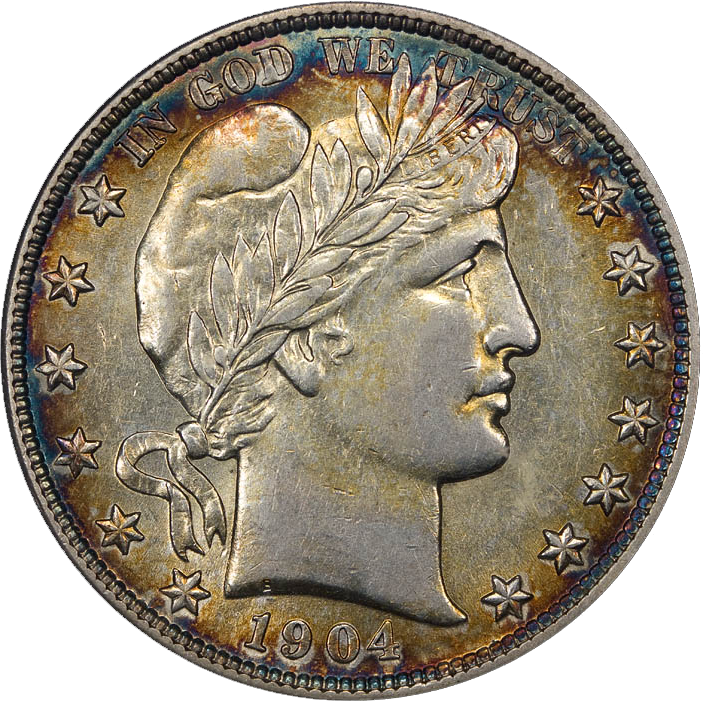
The 1892–1915 Barber half dollar — the largest of the Barber silver coins, with no single million-dollar stopper but a long list of condition rarities led by the 1904-S and 1914.
History
- The Barber half dollar is the largest of the three silver denominations designed by Chief Engraver Charles E. Barber, struck from 1892 through 1915. It replaced the Seated Liberty half dollar under the same 1890 law that triggered the dime and quarter redesigns; President Benjamin Harrison approved Barber’s designs in November 1891, and striking began in January 1892 (Wikipedia; PCGS).
- The obverse matches the Barber quarter: Liberty facing right in a Phrygian cap with the LIBERTY band, six stars left and seven right, IN GOD WE TRUST above, the date below. The reverse shows the heraldic eagle of the Great Seal with a ribbon reading E PLURIBUS UNUM in its beak, beneath 13 stars (PCGS).
- The series ran one year shorter than the dime and quarter — it ended in 1915 because the Walking Liberty half dollar arrived a year before the Mercury dime and Standing Liberty quarter, in 1916 (PCGS).
- Walter Breen called it a series with “no significant rarities,” but PCGS’s Dave Bowers counters that condition rarities abound — many dates are genuinely hard to find in high grade (PCGS).
What is it worth
- Most circulated common dates trade at moderate premiums over melt, since every issue is 90% silver; the coin contains 0.36169 oz of pure silver (Wikipedia; PCGS).
- Proofs were struck each year from 1892 to 1915 in runs of 500 to 900 and carry strong premiums (PCGS).
Key dates in the series
- 1904-S — “one of the stars of the Barber Half Dollar series.” With a mintage of 553,038, it books around $95 in G-4 and about $3,500 in XF-40 in current guides; David Akers calls it the rarest regular issue in Mint State except for the 1892-O Micro O, and the finest known (MS-67) brought $91,062.50 at Heritage in 2016 (PCGS). The site’s dedicated 1904-S entry carries sourced per-date figures.
- 1914 — the lowest-mintage issue of the entire series. PCGS notes it “may be cheap in lower grades” but is “very difficult in Mint State,” with only about 300 known in MS-60 or better and roughly 40 in MS-65 or above; it books around $135 in G-4 and $1,200 in XF-40, with the auction record $37,375 for an MS-66 in 2010 (PCGS). The site’s dedicated 1914 entry carries sourced per-date figures.
- Other tough dates include the 1892-O and 1892-S first-year issues, the 1893-S, the 1896-O, the 1897-O and 1897-S, and the 1915 (PCGS). The 1896-O, with a mintage of 924,000, is elusive and books about $3,200 in XF-40 (PCGS).
What drives the premium
- Grade rarity dominates: many dates that are cheap in G-4 become serious money in XF and beyond — the 1914 and 1904-S are the prime examples (PCGS).
- Mint mark and low mintage: San Francisco and late-series Philadelphia issues carry the premiums (PCGS).
- Originality: uncleaned, naturally toned survivors are scarcer than they should be for a heavily circulated series and sell for more (PCGS).
- Mint State scarcity: most of the series’ best coins come from small proof mintages or from original rolls that were saved, so gem examples are condition rarities rather than absolute rarities (PCGS).
Specifications
- Composition: 90% silver, 10% copper (Wikipedia)
- Weight: 12.50 g (Wikipedia)
- Silver content: 0.36169 troy oz ASW (Wikipedia)
- Diameter: 30.6 mm (Wikipedia)
- Edge: Reeded (Wikipedia)
- Designer: Charles E. Barber (Wikipedia)
- Mints: Philadelphia and San Francisco 1892–1915, New Orleans through 1909, Denver from 1906 (PCGS)
- Years: 1892–1915 (Wikipedia)
Collector notes
- Because there is no seven-figure stopper like the 1894-S dime, a complete date-and-mintmark set of Barber halves is achievable for well-funded collectors — the challenge is condition, not absolute rarity (PCGS).
- The 1892-O Micro O variety is a recognized condition rarity alongside the 1904-S in Mint State (PCGS).
- Many Barber halves show heavy wear or old cleanings; look for original skin and avoid coins with hairlines from polishing (PCGS).
- The mint mark is on the reverse beneath the eagle’s tail — Denver and San Francisco examples from 1906 onward carry D and S there (PCGS).
Market check
Compare live listings for this coin on eBay:
Search eBay for Barber Half Dollars
As an eBay Partner, The Coin Wiki may earn from qualifying purchases.
Sources
- PCGS CoinFacts — Barber Half Dollar: https://www.pcgs.com/coinfacts/category/barber-half-dollar-1892-1915/732
- Wikipedia — Barber coinage: https://en.wikipedia.org/wiki/Barber_coinage
- PCGS — 1914 Barber half, lowest mintage: https://www.pcgs.com/news/1914-barber-half-dollar-has-lowest-mintage-of-the-series
- PCGS — 1904-S Barber half: https://www.pcgs.com/coinfacts/coin/1904-s-50c/6500