
Specifications
- Denomination
- Quarter dollar
- Series
- Barber quarter
- Designer
- Charles E. Barber
- Years of issue
- 1892–1916
- Weight
- 6.25 g
- Diameter
- 24.3 mm
- Edge
- Reeded
The 1892–1916 Barber quarter — the “workhorse” silver quarter of the early 1900s, with three major keys: the 1896-S, the 1901-S, and the 1913-S.
History
- The Barber quarter is the middle child of the three silver denominations designed by Chief Engraver Charles E. Barber, struck from 1892 through 1916. Like the dime and half dollar, it replaced the Seated Liberty design after an 1890 law made every U.S. coin eligible for redesign 25 years after its debut (PCGS).
- When Mint Director Edward O. Leech’s 1891 design competition collapsed — invited artists refused the $500-only terms and the jury of Augustus Saint-Gaudens, Barber, and Henry Mitchell rejected all entries — Barber was ordered to design the new coinage himself. President Benjamin Harrison approved the designs in November 1891 and striking began in January 1892 (Wikipedia).
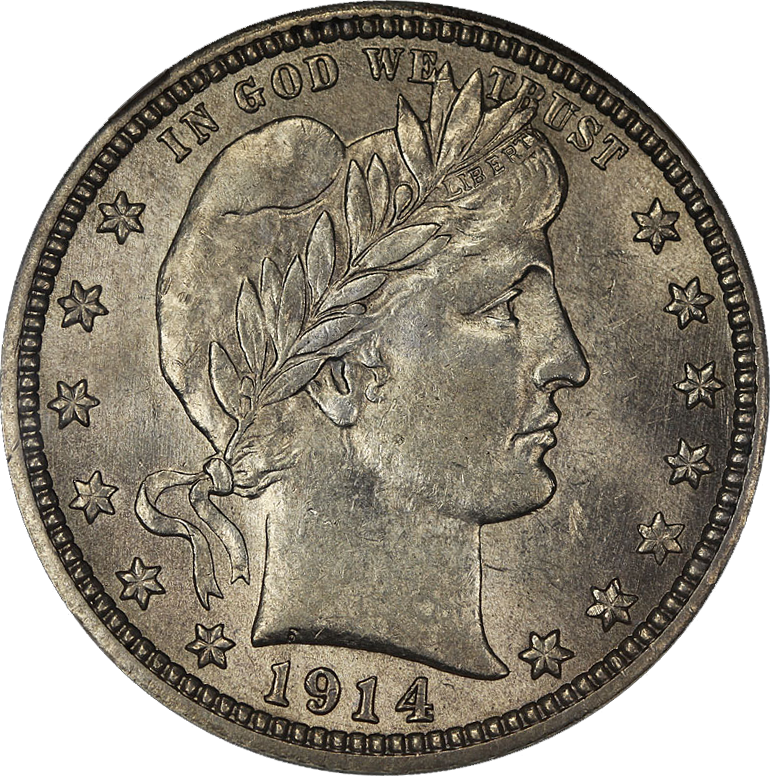
- The obverse shows Liberty facing right in a Phrygian cap with the LIBERTY band, framed by six stars on the left and seven on the right, with IN GOD WE TRUST above and the date below. The reverse is the heraldic eagle of the Great Seal — olive branch and arrows deliberately transposed from their positions on earlier quarter reverses — beneath 13 stars, with QUARTER DOLLAR and UNITED STATES OF AMERICA around (PCGS).
- In 1916 the Standing Liberty quarter replaced the Barber design. Ron Guth of PCGS describes the Barber quarter series as “perhaps the most challenging” of the three Barber denominations for collectors (PCGS).
What is it worth
- Most circulated common dates are the affordable part of the set, trading at modest premiums to melt; the three keys carry almost all of the series’ premium (PCGS).
- Proofs were struck each year from 1892 to 1915 in quantities of 500 to 900 annually and carry strong collector premiums (PCGS).
Key dates in the series
- 1901-S — the series stopper: a major 20th-century rarity with a mintage of only 72,664. Older published figures from the same source put it around $4,000 in G-4, $37,500 in MS-60, and $65,000 in MS-65 (Numismatic News). The site’s dedicated 1901-S entry carries sourced per-date figures.
- 1913-S — the lowest-mintage regular issue at 40,000 pieces, tied with the 1896-S as one of the two most difficult dates; older published figures put it around $1,250 in G-4, $14,250 in MS-60, and $31,000 in MS-65. Ron Guth notes some 1913-S examples show a small die crack below the eagle’s claw (PCGS; Numismatic News). The site’s dedicated 1913-S entry carries sourced per-date figures.
- 1896-S — the first-year San Francisco issue (mintage 188,039) and the most available of the three major keys; NGC’s guide puts it around $870 in G-4 and $8,220 in MS-60 (PCGS; NGC). The site’s dedicated 1896-S entry carries sourced per-date figures.
What drives the premium
- The three keys — 1896-S, 1901-S, and 1913-S — drive nearly all of the series’ premium; common dates are comparatively affordable (PCGS).
- Grade rarity: PCGS notes that well-circulated common dates are inexpensive, but Uncirculated coins and high-grade keys command serious money (PCGS).
- Counterfeit risk: the 1896-S is heavily counterfeited, including examples with added mint marks, so key dates should be bought certified (NGC).
- Originality and eye appeal: PCGS highlights that attractively toned, original coins bring premiums (PCGS).
Specifications
- Composition: 90% silver, 10% copper (Wikipedia)
- Weight: 6.25 g (Wikipedia)
- Silver content: 0.18084 troy oz ASW (Wikipedia)
- Diameter: 24.3 mm (Wikipedia)
- Edge: Reeded (Wikipedia)
- Designer: Charles E. Barber (Wikipedia)
- Mints: Philadelphia, New Orleans, San Francisco, Denver (Wikipedia)
- Years: 1892–1916 (Wikipedia)
Collector notes
- The quarter’s obverse is identical to the half dollar’s except for the size; the mint mark location differs by denomination (PCGS).
- For a date run, expect the three keys to be the last holes filled — they are “the principal rarities of the series” (PCGS).
- Most surviving examples are well worn from decades of commerce; original AU and Uncirculated pieces are the condition rarities for common dates (PCGS).
- The series gets little respect relative to its difficulty, which is exactly why some collectors specialize in it (PCGS).
Market check
Compare live listings for this coin on eBay:
Search eBay for Barber Quarters
As an eBay Partner, The Coin Wiki may earn from qualifying purchases.
Sources
- PCGS CoinFacts — Barber Quarter: https://www.pcgs.com/coinfacts/category/barber-quarter-1892-1916/716
- Wikipedia — Barber coinage: https://en.wikipedia.org/wiki/Barber_coinage
- NGC — counterfeit 1896-S warning: https://www.ngccoin.com/news/viewarticle.aspx?NewsletterNewsArticleID=2011
- Numismatic News — 1913-S and 1901-S Barber values: https://www.numismaticnews.net/collecting-101/1913-s-barber-no-place-go
FREE DOWNLOAD
Before you spend that coin, check it.
The Pocket Change Key-Date Checklist covers the cents, nickels, dimes, quarters and halves still hiding in circulation — including the 1943 and 1983 errors worth five figures. One page to print, a lifetime of jars to check.