
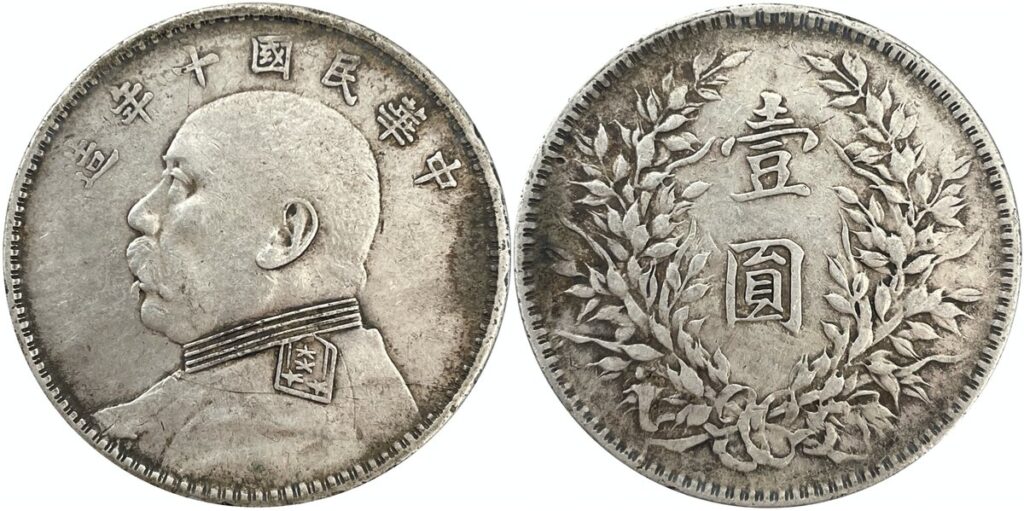
The “Fat Man” dollar — Yuan Shih-kai’s portrait silver yuan — was the most widely circulated silver coin of early Republican China and remains the entry point for Chinese coin collecting. This entry covers its design, specifications, and what to look for when buying.
Key facts
- Designed by Luigi Giorgi, chief engraver of the Tianjin (Tientsin) Mint; first issued in 1914 (Republic Year 3), with the final design showing Yuan in left-facing profile in military uniform, denomination 壹圓 (one yuan) in a grain wreath on the reverse (Wikipedia, citing numismatic references).
- Official weight 26.4 g (72 candareen = 72% of the standardized Kuping tael), 39 mm diameter; fineness intended at .900 but reduced to .89 as recoinage absorbed lower-fineness provincial dollars (Wikipedia).
- Struck dated Republic Years 3–10 (1914–1921, KM-Y329); production continued after Yuan’s death in 1916 because the coins were ubiquitous and trusted (Wikipedia; Virasat Auctions catalog reference Y#329).
- A scarcer 1914 “Plumed Hat” commemorative of the Republic’s founding (KM-Y322, Tientsin, 26.7 g) was struck in far smaller numbers — Heritage lists its mintage at 20,000 — and is a separate, premium issue.
Market check
As an eBay Partner, The Coin Wiki may earn from qualifying purchases.
FREE DOWNLOAD
Before you spend that coin, check it.
The Pocket Change Key-Date Checklist covers the cents, nickels, dimes, quarters and halves still hiding in circulation — including the 1943 and 1983 errors worth five figures. One page to print, a lifetime of jars to check.