
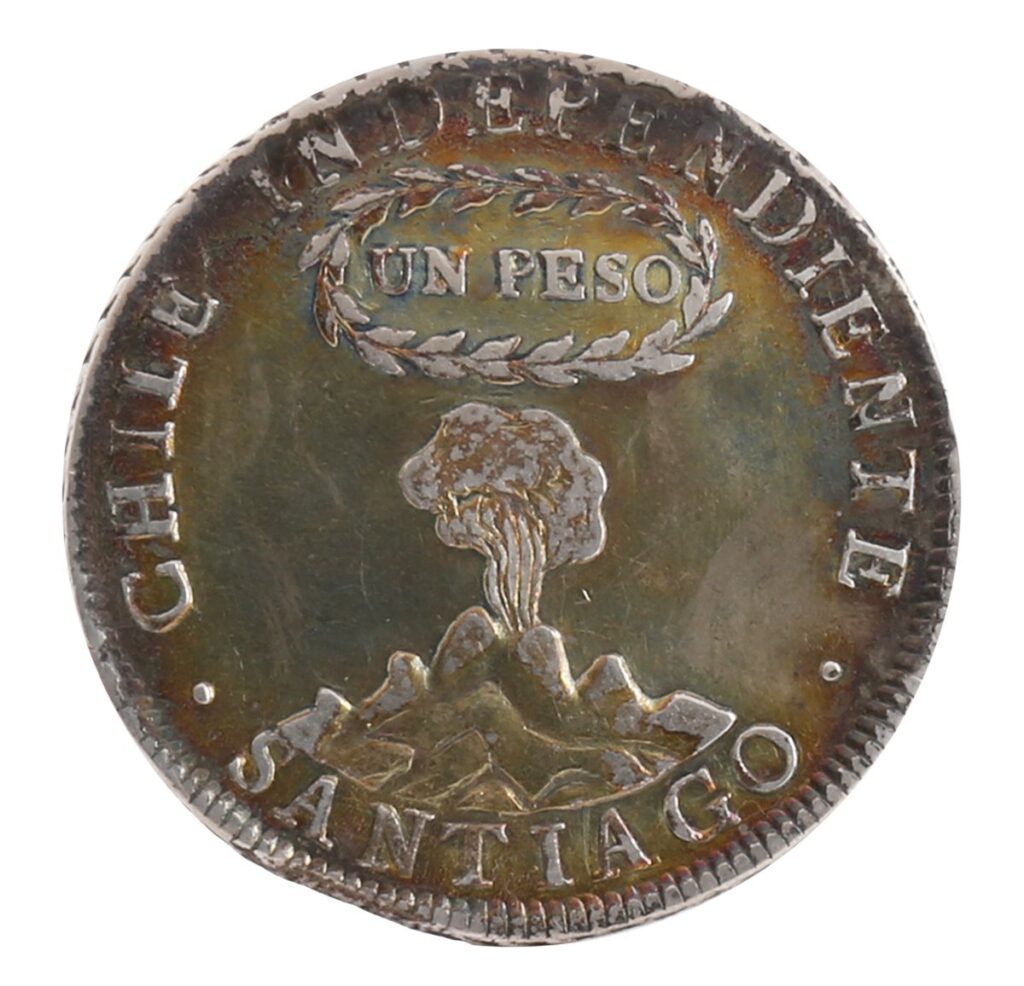
Ordered days after the Battle of Chacabuco, the volcano peso was Chile’s first national coin — an erupting volcano for a new nation’s energy, struck 1817–1834 at Santiago.
History
- Chile’s first national coin, struck 1817–1834 at Santiago (So) — the first to carry the new republican national symbols.
- Ordered June 9, 1817 by interim governor Hilarión de la Quintana (for Bernardo O’Higgins) after the Chacabuco victory.
- Obverse: the liberty column topped by a globe lit by a star, legend "UNION Y FUERZA / LIBERTAD"; reverse: an erupting volcano — O’Higgins’s chosen emblem of the new nation’s energy — with "UN PESO" in a laurel wreath, "CHILE INDEPENDIENTE" above and "SANTIAGO" below.
- Engraver: Francisco Borja Venegas; the same design was used on the 1/2, 1 and 2 reales silver.
Key dates & varieties
- Key variety: the inaugural 1817 issue lacking assayer initials (KM82.1, "Y centered" in UNION Y FUERZA) — reportedly struck for only about one month while the assayer was suspended. The normal assayer-marked sequence (FJ, FD, FI, I) follows.
- Mintage highlights: 1825 is the lowest at 3,400; 1830 at 6,868; last date 1834 at 43,000; early dates include 1818/7 at 371,000.
- An iconic Latin American crown type, heavily collected in high grade.
Specifications
- Weight: 27 g; fineness .902 silver; diameter 39.5 mm (KM82.1/KM82.2).
Collector notes
- No source identifies a specific volcano on the design — it is a symbolic erupting volcano, not a named peak; beware sellers who claim otherwise.
Market check
As an eBay Partner, The Coin Wiki may earn from qualifying purchases.
FREE DOWNLOAD
Before you spend that coin, check it.
The Pocket Change Key-Date Checklist covers the cents, nickels, dimes, quarters and halves still hiding in circulation — including the 1943 and 1983 errors worth five figures. One page to print, a lifetime of jars to check.