
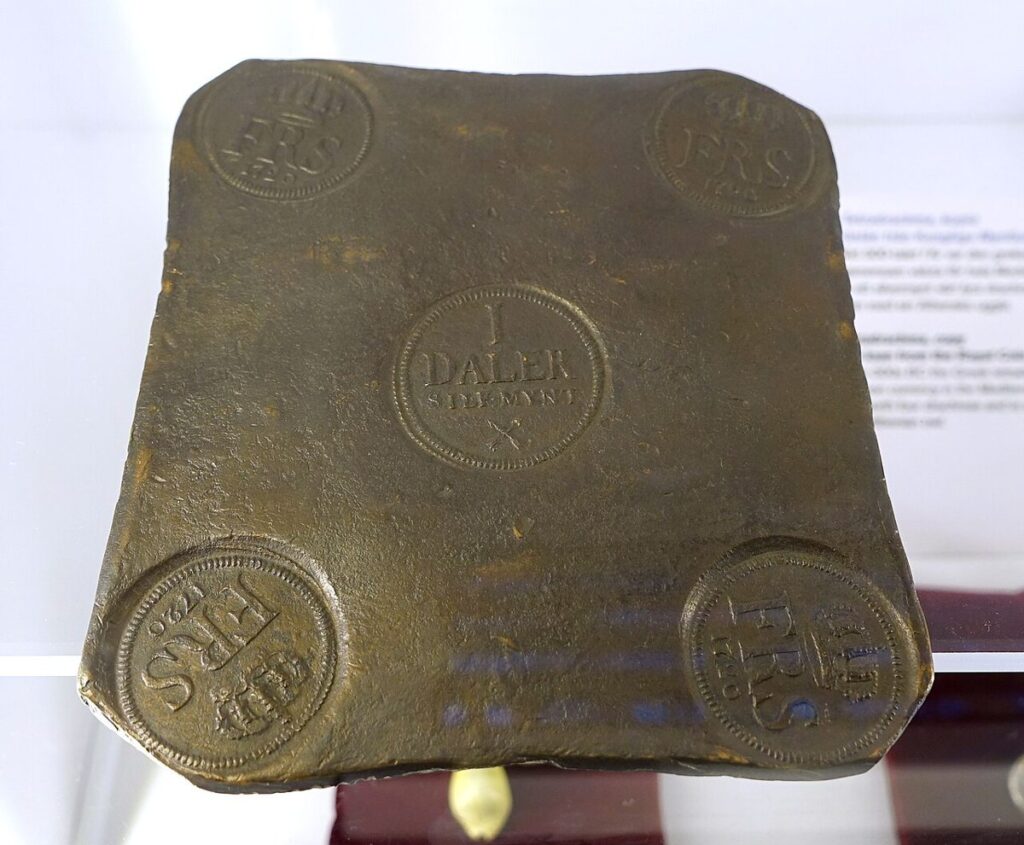
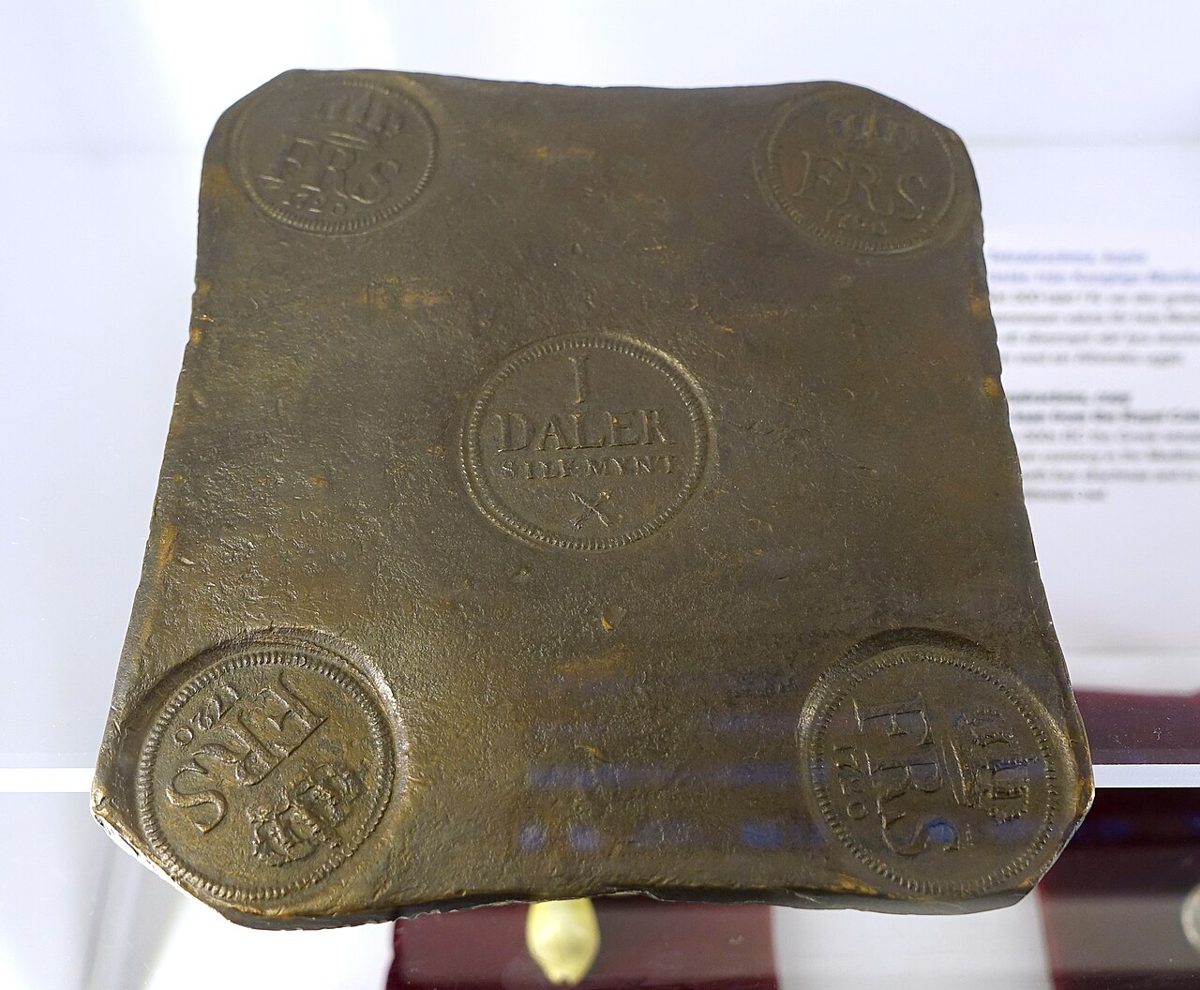
The largest coins ever struck: rectangular copper plates stamped in the corners and center, issued because Sweden’s silver reserves were thin and its copper mines were the richest in Europe. The 1644 debut plates were 10 daler at 19.7 kg; 1-daler plates began in 1649. Their sheer inconvenience pushed Sweden to issue Europe’s first banknotes (Stockholms Banco, 1661).
Key facts
- Copper plate money (plåtmynt) was introduced in 1644; denominations ran from half a daler to 10 dalers (the 10-daler plate, the largest, was discontinued in 1648, the 8-daler in 1682).
- Plates were hammered sheets cut to size, stamped in the four corners with the ruler’s name/initials and year, with the denomination stamped in the center; the reverse is blank.
- The original 1-daler plate weighed about 3.5 pounds (~1.6 kg); surviving examples of later-issue 1-daler plates (e.g. ca. 1715–1716, stamped I DALER S:M) weigh roughly 540–740 g — weight fell over time while the nominal silver equivalence was retained.
- The government formally abandoned the copper standard and discontinued plate money in November 1766. Sources differ on final circulation, with some extending it into the 1770s. Most plates were later melted; originals — including shipwreck recoveries such as the 1783 Nicobar wreck — are scarce.
Market check
As an eBay Partner, The Coin Wiki may earn from qualifying purchases.