Specifications
- Denomination
- 10c
- Series
- Mercury dime (1916-1945)
- Designer
- Adolph A. Weinman
- Years of issue
- 1942
- Composition
- 90% Silver, 10% Copper
- Weight
- 2.5 g
- Diameter
- 17.9 mm
- Edge
- Reeded
- KM
- KM#140
- Key mintages
- No separate production figure exists for the overdate at either mint; parent 1942 totals: 205,410,000 Philadelphia, 60,740,000 Denver (PCGS CoinFacts; GreatCollections). Variety: Overdate FS-101 (FS-010.7 Philadelphia, FS-010.8 Denver).
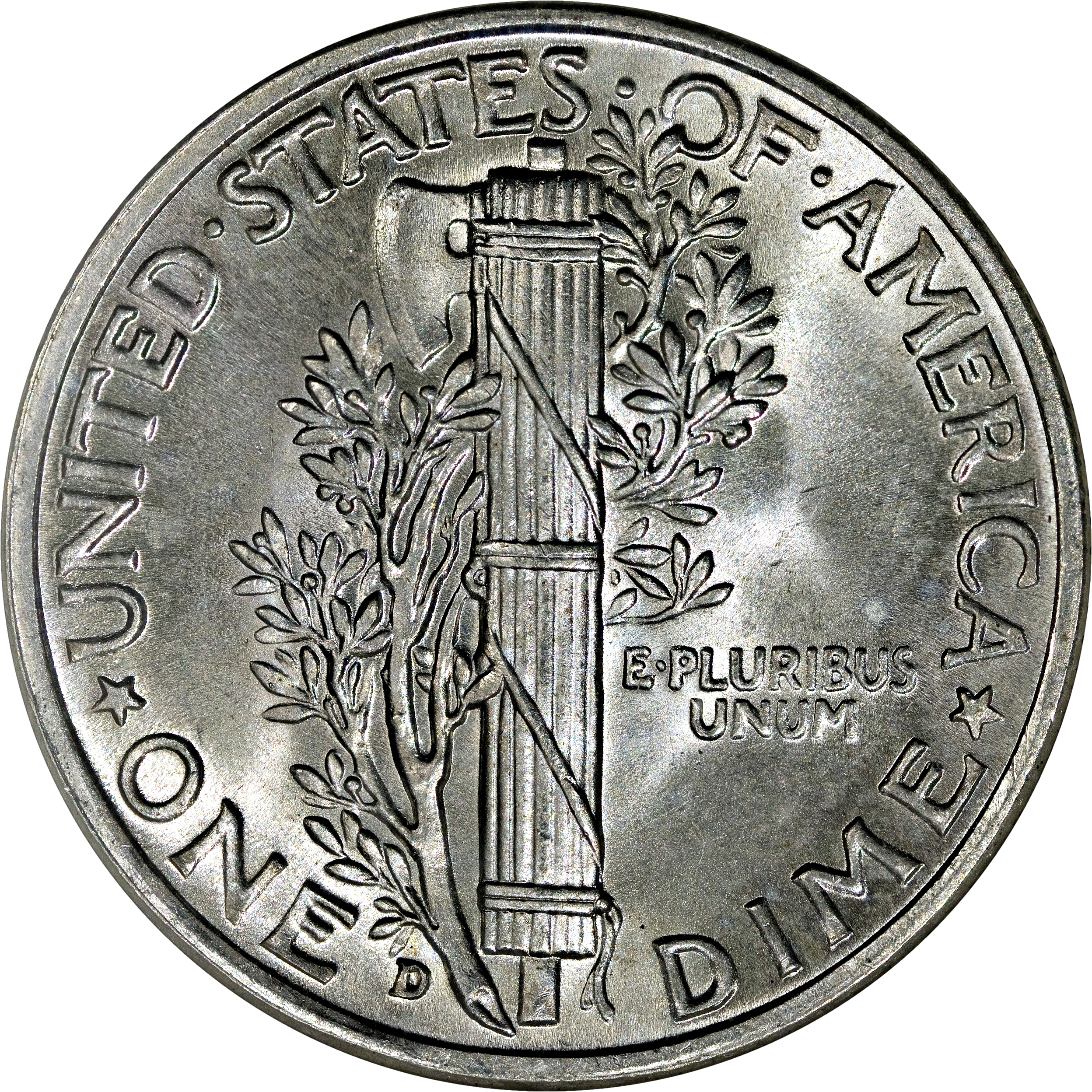
The famous 1942-over-1941 overdate, struck at Philadelphia and Denver; no separate mintage.
History
- The 1942/1 overdate shows Adolph A. Weinman’s Winged Liberty head facing left, with the overdate visible in the date at the lower right of the bust; the reverse carries a fasces bound with an olive branch (NGC via CoinWeek; Wikipedia; accessed 2026-09-16)
- The overdate was created when a working die received one impression from a 1941-dated hub and a second from a 1942 hub, leaving traces of the underlying 1 beneath the 2 (NGC via CoinWeek; accessed 2026-09-16)
- The variety was discovered and announced in 1943; the error apparently occurred twice, and by chance one of the two dies was shipped to Denver, creating the scarcer but less famous 1942/1-D (NGC via CoinWeek; accessed 2026-09-16)
- Genuine Philadelphia examples show doubling on the 4, especially at the base, with the underlying 1 sharply defined and clearly visible; the two most common fakes are altered dates and outright counterfeits (NGC via CoinWeek; accessed 2026-09-16)
- The Denver under-date is far less pronounced than Philadelphia’s. A supposed 1942/1-S is an impossible variety — no such issue exists — and PCGS CoinFacts publishes close-up reference photography of genuine examples for comparison (NGC via CoinWeek; CoinHub; PCGS CoinFacts; accessed 2026-09-16)
Key dates and varieties
- No separate production figure exists for the overdate at either mint. Philadelphia’s affected coins came from within that mint’s total 1942 production of 205,410,000, while Denver’s 1942 total was 60,740,000 (GreatCollections; PCGS CoinFacts; accessed 2026-09-16)
- Famous overdate; scarce in Mint State and extremely rare with Full Bands (Greysheet; accessed 2026-09-16)
Specifications
- composition
- designers
- diameter
- edge
- mint
- weight
Collector notes
- Philadelphia diagnostic: doubling on the 4, especially at the base, with the underlying 1 sharply defined and clearly visible — the two most common fakes are altered dates and outright counterfeits (NGC via CoinWeek; accessed 2026-09-16)
- The Denver under-date is far less pronounced than Philadelphia’s — don’t dismiss a Denver coin for a subtle under-date (NGC via CoinWeek; accessed 2026-09-16)
- A 1942/1-S is impossible — no such issue exists; compare against PCGS CoinFacts close-up reference photography of genuine examples (CoinHub; PCGS CoinFacts; accessed 2026-09-16)
Discovery
The 1942/1 overdate was discovered in 1943 by collector Arnold Kohn and quickly became one of the most famous overdates in American numismatics, a coin generations of collectors have pulled from pocket change and bank rolls. (CoinWeek; accessed 2026-09-17)
Diagnostics and die markers
- The doubling is hub doubling on the die, not machine doubling: the date shows a notched or doubled 4 with undertype visible on the other date digits — the variety is more precisely a 1942/41. (CoinWeek; accessed 2026-09-17)
- The hub doubling also shows on the motto IN GOD WE TRUST and on the Y of LIBERTY. (CoinWeek; accessed 2026-09-17)
- A diagonal die-polish line runs from the crossbar of the 4 to the rim — a useful confirmation marker on genuine examples. (CoinWeek; accessed 2026-09-17)
- A second polish line runs from the base of the fasces toward the olive stem on the reverse. (CoinWeek; accessed 2026-09-17)
Philadelphia vs. Denver
A separate and distinct 1942/1-D overdate was produced at Denver and is collected alongside the Philadelphia coin. This entry covers the Philadelphia 1942/1 (FS-101). (CoinWeek; accessed 2026-09-17)
Full Bands rarity
With Full Bands detail the 1942/1 becomes a major rarity. Greysheet notes that fewer than 100 Full Bands examples are thought to exist across all Mint State grades, with only two or three dozen known in MS65 or better. (Greysheet; accessed 2026-09-17)
Greysheet’s CPG retail lists $156,000 in MS66 Full Bands ($120,000 on the CAC line). In 2010 one collector paid $63,250 for a PCGS MS66FB example. (Greysheet; accessed 2026-09-17)
Notable auction results
- Heritage, May 9, 2024 — PCGS MS66 Full Bands, sold for $102,000 (Greysheet; accessed 2026-09-17)
- Heritage, January 15, 2025 — PCGS MS65 Full Bands CAC, sold for $72,000 (Greysheet; accessed 2026-09-17)
- Heritage, February 27, 2025 — PCGS MS63 Full Bands, sold for $14,400 (Greysheet; accessed 2026-09-17)
- Stack’s Bowers, August 11, 2023 — EF-40 ANACS (circulated), sold for $552 (Greysheet; accessed 2026-09-17)
What drives value
- Circulated examples are relatively available and far more affordable; the major premiums begin in Mint State and explode with Full Bands detail. (Greysheet; accessed 2026-09-17)
- Counterfeit 1942/1 dimes exist, so certification by PCGS or NGC is strongly recommended before buying. (Research notes; CoinWeek; accessed 2026-09-17)
Market check
Compare live listings for this coin on eBay:
Search eBay for 1942/1 Mercury Dime
As an eBay Partner, The Coin Wiki may earn from qualifying purchases.