
Specifications
- Denomination
- 25 cents
- Series
- Barber Quarter
- Designer
- Charles E. Barber
- Engraver
- Charles E. Barber
- Years of issue
- 1901
- Composition
- 10% Copper, 90% Silver
- Weight
- 6.25 g
- Diameter
- 24.3 mm
- Edge
- Reeded
- Mintage
- 72664
- Key mintages
- Business strikes.
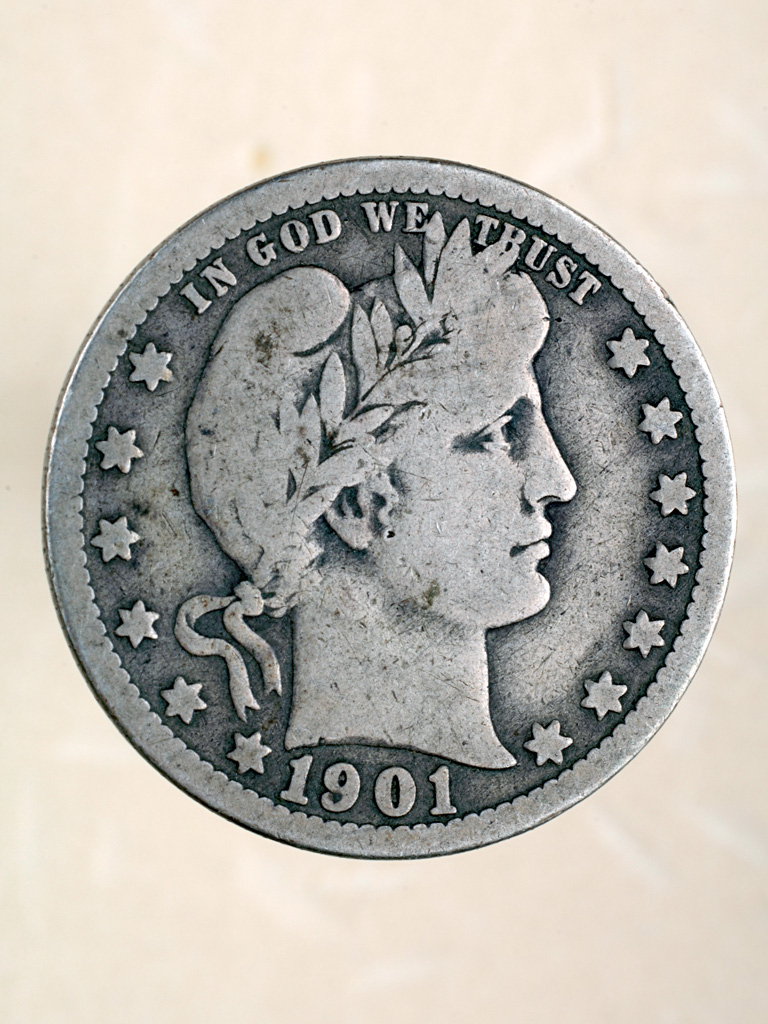
The king of the Barber quarters — not the lowest mintage, but the toughest to find after a century of heavy circulation.
History
- The 1901-S Barber quarter had an original mintage of 72,664 coins, very low for the era (PCGS CoinFacts, David Hall; accessed 2026-09-16).
- It is NOT the lowest-mintage Barber quarter: that distinction belongs to the 1913-S, with a mintage of only 40,000 — the lowest-mintage silver coin of the 20th century (Numismatic News; accessed 2026-09-16).
- Despite its higher mintage, the 1901-S is tougher than the 1913-S because it was almost never saved: branch-mint collecting wasn’t common in 1901, and most of the small mintage went straight into heavy West Coast circulation (PCGS CoinFacts, David Hall; accessed 2026-09-16).
- David Hall calls it ‘the rarest regular issue (non-variety) silver coin of the 20th century,’ and most survivors grade AG3 or G4; mint state specimens are very rare, with an estimated 10–20 Gem MS65-or-better examples (PCGS CoinFacts; accessed 2026-09-16).
- The finest known example, graded PCGS MS68, was purchased by David Lawrence Rare Coins at a Bowers and Merena auction on March 4, 2010 (PCGS CoinFacts, Jaime Hernandez; accessed 2026-09-16).
- A PCGS MS67 CAC example from the Gardner Collection sold in the Heritage June 2014 auction for $258,500 (Heritage Auctions lot 1213-30428; accessed 2026-09-16).
- A notable ‘schoolhouse’ discovery: an uncirculated 1901-S found in a Reno, Nevada schoolhouse cornerstone in 1994 was graded PCGS MS65 and consigned to Stack’s (PCGS CoinFacts, Jaime Hernandez; accessed 2026-09-16).
Specifications
- Weight: 6.25 grams — standard Barber quarter spec; accessed 2026-09-16
- Composition: 90% silver, 10% copper — standard Barber quarter spec; accessed 2026-09-16
- Diameter: 24.3 mm — standard Barber quarter spec; accessed 2026-09-16
- Designer: Charles E. Barber — standard Barber quarter attribution; accessed 2026-09-16
- Mint: San Francisco; Philadelphia issues have no mintmark
Certified populations: PCGS had certified two in MS67, one in MS67+, and one MS68; NGC had graded two Superb Gems and none finer (Heritage Auctions lot description, May 2014; accessed 2026-09-16). Heritage cautioned these populations likely contain duplicate resubmissions.
Collector notes
- The 1901-S is one of the most counterfeited U.S. coins, typically an added ‘S’ on a genuine 1901 Philadelphia quarter — buy only examples certified by PCGS or NGC, and verify the certification number.
- Authentication rests heavily on mintmark position and style plus die characteristics; Heritage notes the small certified Mint State populations include duplicate resubmissions, so population reports overstate survivors.
- Typical surviving examples are AG–G; any Mint State or AU claim needs professional grading, as cleaned or tooled coins are common in the marketplace.
- Because the 1913-S (40,000 mintage) is cheaper than the 1901-S in most grades, new collectors should understand that mintage alone doesn’t set value — survival rate does.
Market check
Compare live listings for this coin on eBay:
Search eBay for 1901-S Barber Quarter
As an eBay Partner, The Coin Wiki may earn from qualifying purchases.
Related Coins
Live on eBay
Live asking prices — not sale records.
 1901-S 25c Barber Quarter NGC G4$5,175.00View on eBay
 1901-S 25c Barber Quarter NGC G04 CAC$6,750.95View on eBay
 1901-S Barber Quarter PCGS FR2 Key Date Decent Eye Appeal$3,380.00View on eBay
As an eBay Partner, The Coin Wiki may earn from qualifying purchases.
FREE DOWNLOAD
Before you spend that coin, check it.
The Pocket Change Key-Date Checklist covers the cents, nickels, dimes, quarters and halves still hiding in circulation — including the 1943 and 1983 errors worth five figures. One page to print, a lifetime of jars to check.