
Specifications
- Denomination
- 50 cents
- Series
- Franklin Half Dollar
- Designer
- John R. Sinnock
- Engraver
- Gilroy Roberts
- Years of issue
- 1948–1963
- Composition
- 90% Silver, 10% Copper
- Weight
- 12.5 g
- Diameter
- 30.6 mm
- Edge
- Reeded
- KM
- KM-199
Melt value: $14.91
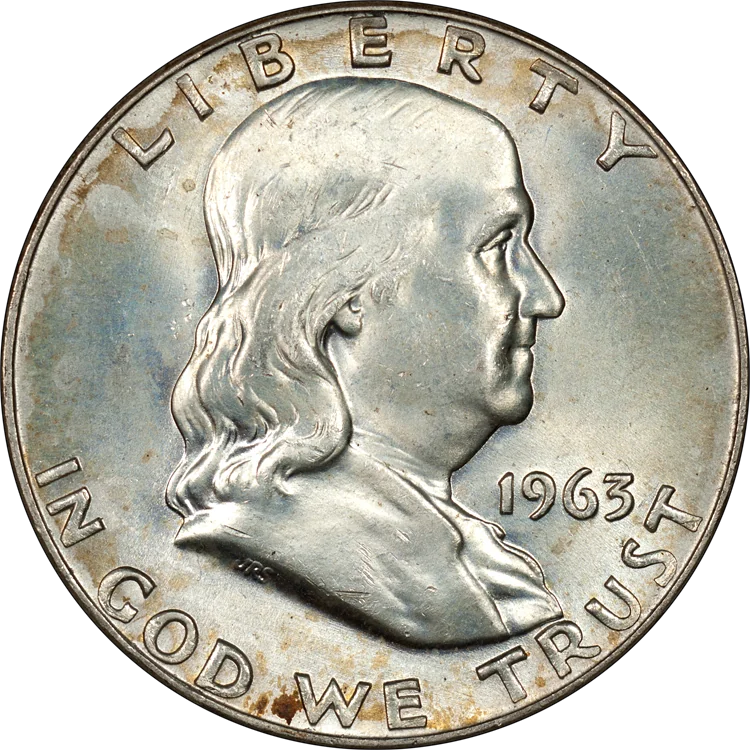
The only major U.S. coin honoring a non-president — a bell with a crack, a tiny eagle, and Full Bell Lines that can turn pocket change into thousands.
History
- Designed by Chief Engraver John R. Sinnock and struck 1948–1963; it was the first major U.S. coin to honor a non-president — Benjamin Franklin — and it replaced the Walking Liberty half dollar (Coin World, accessed 2026-09-16).
- Sinnock died before the coin’s release; the reverse was completed from his 1926 Sesquicentennial half-dollar Liberty Bell design with assistance from Gilroy Roberts, the next chief engraver (coinexchangeny.com, accessed 2026-09-16).
- The reverse’s tiny eagle exists because federal law then required an eagle on every half dollar reverse — the small bird drew complaints for its unmajestic look, as did the prominently displayed crack in the Liberty Bell (coinexchangeny.com, accessed 2026-09-16).
- Full Bell Lines (FBL) is the strike designation: PCGS requires MS-60 or better with complete, uninterrupted lower lines on the Liberty Bell — a sharp strike that San Francisco issues notoriously lack (Numismatic News, accessed 2026-09-16).
- The 1955 ‘Bugs Bunny’ variety — Franklin appearing to have buck teeth — is a die clash, where the dies struck each other without a planchet, impressing design details across; the 1955 is the most famous (Coin World, accessed 2026-09-16).
- Proofs were struck 1950–1963 (lowest mintage 1950); the series ended in 1963 after President Kennedy’s assassination, replaced by the Kennedy half in 1964 (Coin World, accessed 2026-09-16).
- With mintages from about 2.5 million to 67 million (the 1963-D), the series has no true rarity by mintage — condition and strike do the heavy lifting (Numismatic News, accessed 2026-09-16).
Key dates and varieties
- 1948 (P) — first-year issue, mintage 3,006,814; a modest mintage that anchors the series (findrarecoins.com, accessed 2026-09-16).
- 1949-S — mintage 3,744,000, one of the lower mintages and a key date (Coin World, accessed 2026-09-16).
- 1953 (P) — mintage 2,796,920; difficult to find well struck, with Full Bell Lines examples commanding strong premiums (findrarecoins.com / Numismatic News, accessed 2026-09-16).
- 1955 (P) — mintage 2,498,181, the lowest business-strike mintage in the series and home of the Bugs Bunny die clash (Numismatic News, accessed 2026-09-16).
- 1953-S with Full Bell Lines — PCGS has designated only 42 examples, versus 4,936 for the 1953-D; a strike-rarity trophy (Numismatic News, accessed 2026-09-16).
- 1961 doubled-die reverse proof — a notable proof variety beyond the 35-coin business set (Coin World, accessed 2026-09-16).
Specifications
- Weight: 12.50 g (Coin World, accessed 2026-09-16).
- Composition: 90% silver, 10% copper; actual silver weight 0.36169 troy oz (Coin World, accessed 2026-09-16).
- Diameter: 30.61 mm; edge: reeded (Coin World, accessed 2026-09-16).
- Designers: John R. Sinnock (obverse; reverse based on his 1926 Sesquicentennial design, completed with Gilroy Roberts); engraver Gilroy Roberts (Coin World, accessed 2026-09-16).
- Mintmark: D or S above the bell beam on the reverse; Philadelphia coins have none (Coin World, accessed 2026-09-16).
Collector notes
- Grading quirk: for FBL, all seven incuse bell lines must show completely across the bell, plus three distinct wisps of hair by Franklin’s ear — partial lines don’t count, and standards differ slightly between PCGS and NGC (Coin World, accessed 2026-09-16).
- Strike awareness: 1958-and-later Franklins are commonly found with FBL, so premiums concentrate on 1948–1957 issues — especially San Francisco coins, which were struck from overused dies (Numismatic News, accessed 2026-09-16).
- The Bugs Bunny clash also exists on other dates, but the 1955 is the recognized and most valuable one; authentication is by the die-clash lines near Franklin’s mouth, cataloged as FS-401 (Coin World / Greysheet, accessed 2026-09-16).
- Market guidance: common circulated Franklins trade at silver melt plus a small premium; the money is in certified MS-64/65 FBL early dates — registry-set demand sustains it (Numismatic News, accessed 2026-09-16).
- Rumors of 1964-dated Franklin halves have never been substantiated; don’t pay a premium for a story (Coin World, accessed 2026-09-16).
Market check
Compare live listings for this coin on eBay:
Search eBay for Franklin Half Dollar (1948–1963)
As an eBay Partner, The Coin Wiki may earn from qualifying purchases.
Related Coins
Live on eBay
Live asking prices — not sale records.
 1953-D 50C Franklin Half Dollar MS64 EDC Red$46.00View on eBay
 3x Franklin Half Dollar 50C Silver .900 1951 1953 Philadelphia Business$45.00View on eBay
 1951 50C Franklin Half Dollar PCGS PR63 (90863)$268.79View on eBay
As an eBay Partner, The Coin Wiki may earn from qualifying purchases.
FREE DOWNLOAD
Before you spend that coin, check it.
The Pocket Change Key-Date Checklist covers the cents, nickels, dimes, quarters and halves still hiding in circulation — including the 1943 and 1983 errors worth five figures. One page to print, a lifetime of jars to check.